Revelation 21:3-5 vs. “Hymn of Heaven”
Phil Wickham · checked 2026-08-02
What we checked
Graded against the standard
Quotation criteria not graded: this song never presents its words as scripture
Applies to every song the Name held holy · God shown holy · true of God · the standard
✓ What's good
- Keeps the agent of Revelation 21:4. The tear-wiping stays something God performs, with He as the grammatical subject on both published lyric sheets, rather than a condition that arrives by itself
- Never says it is quoting: no verse reference, no translation named, nothing framed as scripture
- Names two of the four things verse 4 says will pass away, death and pain, and carries crying in the tear line
- The connection is documented rather than inferred: the publisher's own song page lists Revelation 21:4 among the song's scripture references, alongside Romans 14:11
- Stays in the future tense for nearly its whole length, which is the tense the passage itself uses
- Mostly about God rather than about the singer. On the published sheet, twelve of roughly twenty lines are statements about God or the coming day
⚠ Cautions
- The passage leads with presence, not absence. Verse 3 says God's dwelling place is with man and that He will be with them as their God. The song's presence is a face-to-face meeting, a moment rather than a residence
- Verse 5's promise is renewal, and the song does not carry it. Neither published lyric sheet contains the word new. What the song's coming day mostly holds is what stops
- Nothing inside the song says why its future tense is safe. Revelation 21:5 attaches the guarantee explicitly. Bring it with you
- The final chorus moves the day into the present and calls the congregation to sing it now. Christians have always made that move and it is defensible, but it is the song's move. Revelation 21 keeps everything on the far side of the new creation
- The song never addresses God directly. That is descriptive, not a fault, but a worship leader placing it should know the whole song speaks about Him and to the room
Verse Proof
Revelation 21:3-5The text in BSB (Berean Standard Bible)
“And I heard a loud voice from the throne saying: “Behold, the dwelling place of God is with man, and He will dwell with them. They will be His people, and God Himself will be with them as their God. ‘He will wipe away every tear from their eyes,’ and there will be no more death or mourning or crying or pain, for the former things have passed away.” And the One seated on the throne said, “Behold, I make all things new.” Then He said, “Write this down, for these words are faithful and true.”
This is the opening of John's vision of the new heaven and the new earth, with the holy city coming down out of heaven. The words are not John's own. A loud voice from the throne makes the announcement, and the announcement leads with presence: the dwelling place of God is with man, He will dwell with them, they will be His people, and God Himself will be with them as their God. Only after that does the voice list what ends. The tear clause is set off in quotation marks in the Berean Standard Bible because it is the wording of Isaiah 25:8 arriving here as fulfillment. Then the One seated on the throne speaks in His own voice twice: that He is making all things new, and that John is to write this down, because these words are faithful and true. Everything in the passage is future, and the passage says so on purpose. It is a promise delivered in advance and certified in the same breath.
What the song says, described not quoted
The song is three verses and a repeated chorus, with the third verse doing the work a bridge usually does. It opens on a coming day and stays there. The chorus declares a day when everyone bows, a day when death is finished, and the singer standing face to face with the one who died and rose, closing each time on the shortened “holy, holy” cry that belongs to Revelation 4:8. The second verse looks back over prayers and songs offered in hard seasons and says they will be answered when He returns to wipe away tears. The third verse puts the singer's voice alongside the redeemed and the angels in the acclamation of the Lamb's worth and His unending reign. The last chorus turns from the coming day to the present and calls the room to shout the song now. Nothing is presented as a quotation. No verse reference and no translation appears anywhere in the song. It also speaks about God rather than to Him: two independently published lyric sheets contain no second-person address to God at all.
The one thing most worth checking here, the song keeps. In Revelation 21:4 the wiping is an act, not a condition: God does it. The song holds that. Its tear line has He as the subject, and both published lyric sheets agree on it, so the comfort stays something someone performs rather than a state of affairs that settles in. What moves is the occasion. In the text the tears are wiped when the city comes down and God takes up residence; in the song they are wiped when He returns. The list is trimmed. Verse 4 names four things that pass: death, mourning, crying, pain. The song names death and pain, and its tear line carries crying in substance. Mourning does not appear on either sheet. Two sentences of the passage stay outside the song. The first is its headline, verse 3, which is about who will be there rather than what will be gone. The second is verse 5, where the promise turns positive: making all things new is renewal, not removal, and neither lyric sheet uses the word. The song's coming day is largely an ending of bad things plus a meeting. The passage's is a dwelling.
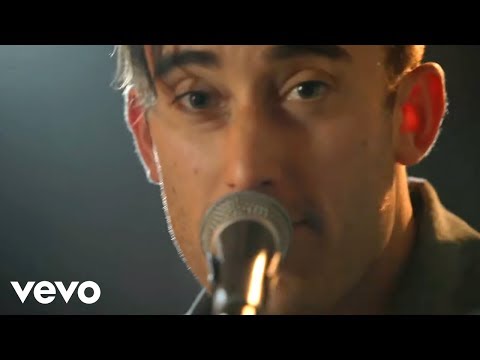
▸ Official upload. Now listen with the proof in mind.
The song sings the day. The passage names the voice that promised it, and tells John to write it down.
Why it matters
Almost every line of this song is about a day that has not arrived. That is not a weakness. Revelation 21 is scripture narrating the future, and singing the future is an ordinary Christian act. But a song in the future tense is a promise being rehearsed, and a rehearsed promise is only as sturdy as whoever made it. The passage answers that in the same breath it makes the promise: the voice comes from the throne, the One seated on the throne speaks, and John is told to write it down because these words are faithful and true. The song sings the day with full confidence and never says where the confidence comes from. A singer who has the chapter is holding a guarantee. A singer who has only the song is holding a hope.
Is it safe to dwell on?
Sung on repeat, this song fixes your attention on God.
This is a song sung to plant a horizon, and it is well built for the job. Twelve of its roughly twenty lines are about God and the day; the remaining eight are the singer's, and the weightiest of those is the second verse's backward look at prayers and songs offered in hard seasons, which is testimony rather than self-regard. What the loop drills in is an expectation about how things end, and Christians are told to carry exactly that (Colossians 3:2, 1 Thessalonians 4:18). Two things are worth adding by hand. The first is verse 3, because the song's coming day is mostly a list of what stops, while the passage's is a sentence about who is there, and repetition will plant whichever version gets sung. The second is that this song never speaks to God, only about Him, so a week of singing it plants a lot of true description and no practiced address. That is an argument for what you put next to it, not against the song.
Helpful comparison
Keep the addresses straight on this one. The chorus tag that everyone remembers, the shortened “holy, holy,” belongs to Revelation 4:8, which has its own proofs on this site. The Lamb's worth in the third verse belongs to Revelation 5:12, which also has one. This proof is only about the Revelation 21 material, which is the tear line and the end of death and pain, and that is also the passage the publisher itself cites.
This is the fifth Phil Wickham song checked here, and the method is consistent across all five. Living Hope, Battle Belongs, House of the Lord and this one make no statement that it is quoting and build from allusion; only This Is Amazing Grace carries a verse's words verbatim, and only partway. The discernment task is therefore the same one every time. Trace the images back to their chapters and see what stayed behind. Here what stayed behind is a sentence about God moving in.
Verse 3 in full says the dwelling place of God is with man, that they will be His people, and that God Himself will be with them as their God. A residence, where the song sings a meeting.
Sources
- Phil Wickham — Hymn Of Heaven (Official Music Video) · (the recording checked for this proof; oEmbed confirms the uploader is PhilWickhamVEVO)
- Worship Together — Hymn Of Heaven song page · (platform-side listing: writers Phil Wickham, Chris Davenport, Brian Johnson and Bill Johnson; CCLI 7168994; scripture references given as Romans 14:11 and Revelation 21:4; first of the two lyric sheets checked for wording)
- PraiseCharts — Hymn Of Heaven · (independent confirmation of the same four writers and CCLI number, publishers listed as Essential, Fair Trade, Bethel and Hillsong; second lyric sheet checked for wording and pronouns)
- Wikipedia — Hymn of Heaven (song) · (album *Hymn of Heaven*, 2021; issued as the third single on 11 February 2022 by Fair Trade Services, produced by Jonathan Smith; Dove Award for Worship Recorded Song of the Year, 2022)
- Song Scoops — Hymn of Heaven · (writing circumstances in 2020 and Wickham's own statements about wanting the perspective of God on the throne, and about the kingdom being present rather than only awaited)
- K-LOVE — Phil Wickham Brings A Glimpse of Eternity to Earth · (Wickham describing the song as both present hope and future hope, and naming his three co-writers)
- The Berean Test — Hymn of Heaven · (line-by-line scripture mapping; identifies the tear-wiping as God's action and maps the second verse to Revelation 21:4)
- Will It Worship — Hymn of Heaven · (structure: three verses, no formal bridge; the song's future orientation and the closing turn to present participation)
- Grace Community Church San Antonio — Hymn of Heaven · (a congregation's own page citing Revelation 21:3-4 and Revelation 4:8 as the texts behind the song)
- Biblical Worship — Hymn of Heaven by Phil Wickham · (independent reading of the tear line with God as the acting subject, and of the song's third-person stance)
Corrections
No corrections to this proof yet.
Think we got something wrong? Tell us what and where, and we will check it against the text. Real errors get fixed here, dated, in public. Every correction on the site →
Where the text survives the song
 ~ FAITHFUL
“Revelation Song”
Jennie Lee Riddle (recorded by Kari Jobe)
Sing it. The chorus is the creatures' song, kept intact, and the images around it come from the same chapter. It just never names a translation, so there is nothing to check the wording against.
~ FAITHFUL
“Revelation Song”
Jennie Lee Riddle (recorded by Kari Jobe)
Sing it. The chorus is the creatures' song, kept intact, and the images around it come from the same chapter. It just never names a translation, so there is nothing to check the wording against.✓ The chorus follows Revelation 4:8 without altering what it says about God
⚠ No translation is named, so the near-verbatim chorus cannot be checked against a stated text. That is the only thing separating this from Word-for-Word Verified
 ~ FAITHFUL
“Agnus Dei”
Michael W. Smith
Sing it. Every sung phrase traces to a Revelation acclamation, and the small shifts are moves the book itself makes. Just know the title names a Mass prayer with different words: the liturgy asks the Lamb for mercy, this song acclaims him.
~ FAITHFUL
“Agnus Dei”
Michael W. Smith
Sing it. Every sung phrase traces to a Revelation acclamation, and the small shifts are moves the book itself makes. Just know the title names a Mass prayer with different words: the liturgy asks the Lamb for mercy, this song acclaims him.✓ Every sung phrase has a checkable Revelation address: the reigning in 19:6, the holy in 4:8, the worthy in 5:12, the amen in 19:4 and 5:14
⚠ The wording is a blend no single Bible prints: the KJV's Alleluia spelling and our-less frame with the modern translations' Almighty. Each piece is a real rendering of 19:6, but no one translation can verify the whole clause, and none is named
 ~ FAITHFUL
“This Is Amazing Grace”
Phil Wickham
Sing it. The bridge's first line is Revelation 5:12 as far as it goes, and what the song adds is true from other texts. Know that the verse itself keeps going, into seven things the Lamb is worthy to receive.
~ FAITHFUL
“This Is Amazing Grace”
Phil Wickham
Sing it. The bridge's first line is Revelation 5:12 as far as it goes, and what the song adds is true from other texts. Know that the verse itself keeps going, into seven things the Lamb is worthy to receive.✓ The bridge's first line carries the acclamation of Revelation 5:12 unaltered as far as it goes, in the wording most modern translations share
⚠ The verse's own ending never appears. Revelation 5:12 gives the Lamb seven things, power, riches, wisdom, strength, honor, glory, blessing, and the song keeps none of them
More songs like this
 NOT A QUOTE
“House of the Lord”
Phil Wickham
Sing it. Nothing here is quoting, and the joy it names is real. Just know that Psalm 122's house of the Lord was a place with gates at the end of a road; the song sings that gladness of the gathered church.
NOT A QUOTE
“House of the Lord”
Phil Wickham
Sing it. Nothing here is quoting, and the joy it names is real. Just know that Psalm 122's house of the Lord was a place with gates at the end of a road; the song sings that gladness of the gathered church.✓ Both verses are built from checkable acts of God: a sea parted (Exodus 14), prison doors opened (Acts 16:26), the cross and the empty tomb, and nothing sung of God here is something the text will not support
⚠ Psalm 122's house is a place: one city, real gates, tribes going up by command. The song's house is the gathered people, and the song does not mark the transfer
 NOT A QUOTE
“Battle Belongs”
Phil Wickham
Sing it. The line is 2 Chronicles 20:15 in plain English and the singing comes from the same chapter. Just remember the promise there was given for one battle, and Judah still had to show up and stand.
NOT A QUOTE
“Battle Belongs”
Phil Wickham
Sing it. The line is 2 Chronicles 20:15 in plain English and the singing comes from the same chapter. Just remember the promise there was given for one battle, and Judah still had to show up and stand.✓ The refrain restates 2 Chronicles 20:15 accurately: the battle is God's, not the singer's
⚠ The promise in the chapter is specific: one prophet, one king, one invasion, one day. The song makes it a general posture
 NOT A QUOTE
“Come Jesus Come”
Stephen McWhirter
Sing it. It is a prayer, not a quotation, and it asks for the same thing the Bible's last chapter asks for. Remember that in scripture the request answers Christ's own promise to come.
NOT A QUOTE
“Come Jesus Come”
Stephen McWhirter
Sing it. It is a prayer, not a quotation, and it asks for the same thing the Bible's last chapter asks for. Remember that in scripture the request answers Christ's own promise to come.✓ Nothing is presented as scripture. The words cite no book, chapter or verse, and no line is framed as a quotation, so nothing in them can be checked and found misquoted
⚠ The verse's prayer is a reply. Christ promises first and the amen follows. The song makes the same request without the promise it answers, so its ground sits outside the words