Revelation 5:12 vs. “This Is Amazing Grace”
Phil Wickham · checked 2026-08-01
What we checked
Graded against the standard
Quotation criteria this song presents words as scripture, so these apply
Applies to every song the Name held holy · God shown holy · true of God · the standard
✓ What's good
- The bridge's first line carries the acclamation of Revelation 5:12 unaltered as far as it goes, in the wording most modern translations share
- What the song adds is defensible from other texts: Revelation 1:18 has the one who died and lives holding the keys of death, and 1 Corinthians 15 calls the resurrection a victory
- The source is documented rather than guessed: Wickham has named Revelation 5:11-13 and 2 Corinthians 6:18 as the passages behind the song
- The verses keep attention on Christ by asking questions only he answers, and the singer appears as the one set free rather than as the subject
⚠ Cautions
- The verse's own ending never appears. Revelation 5:12 gives the Lamb seven things, power, riches, wisdom, strength, honor, glory, blessing, and the song keeps none of them
- The added second line shares the first line's shape, so nothing in the sound marks where the verse stops and the song starts. On repeat the pair is memorised as one continuous acclamation
- No translation is named and no verse is cited anywhere in the song
- In 5:12 the speakers are myriads of angels. The redeemed sing their own song in 5:9-10, and verse 13 brings in every creature, which is where a congregation finds its own place in the scene
Verse Proof
Revelation 5:12The text in BSB (Berean Standard Bible)
“In a loud voice they were saying: “Worthy is the Lamb who was slain, to receive power and riches and wisdom and strength and honor and glory and blessing!”
John has just watched the Lamb take the scroll and heard the living creatures and the elders sing their new song (5:9-10). Then the circle widens. Myriads of angels around the throne, thousands of thousands, say in a loud voice that the slain Lamb is worthy to receive seven things: power, riches, wisdom, strength, honor, glory, blessing. Seven is this book's number for completeness; the angels are handing the Lamb everything. The speakers of verse 12 are angels. The redeemed sang their own song two verses earlier, and in verse 13 every creature everywhere joins in.
What the song says, described not quoted
The verses ask questions and answer them with a royal title. The first asks who breaks the power of sin and whose love is stronger than the dark, and answers with the King of Glory, the title of Psalm 24. The second, the verse Jeremy Riddle rewrote, asks who shakes the earth and yet brings order out of chaos, and who turns orphans into sons and daughters, an echo of 2 Corinthians 6:18. The chorus is sung to Jesus and names the exchange: he took the singer's place, carried the cross, gave up his life, and the singer walks free and sings about it. The bridge opens with the acclamation of Revelation 5:12, word for word as far as “slain,” then adds a matching second line of the song's own, ascribing worthiness to the King for defeating death. It closes on the word worthy, repeated.
The bridge's first line is the verse's opening clause exactly as most modern translations render it, the BSB included. The verse does not stop there. Its acclamation runs on into the sevenfold ascription, and none of the seven survives into the song. In their place stands a second line in the same grammatical shape, declaring the King worthy for his victory over death. That line is true by other texts (Revelation 1:18; 1 Corinthians 15:54-57) and is not far from this chapter's own verb, since 5:5 announces that the Lion has triumphed. But it is not what the angels say in verse 12, and nothing in the song marks where the verse ends. Wickham has publicly named 2 Corinthians 6:18 and Revelation 5:11-13 as the passages behind the song and described the bridge as a glimpse of what will be sung in heaven.
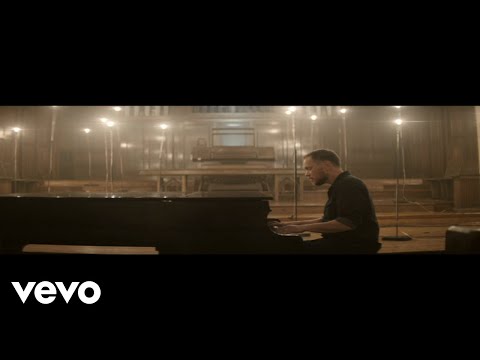
▸ Official upload. Now listen with the proof in mind.
The bridge's first line is the verse. The second is the song. Repetition will remember them as one.
Why it matters
The bridge is the part a congregation belts on repeat, and repetition will file its two lines as one acclamation. Only the first is the verse. The sevenfold list the song leaves out is not decoration: seven is this book's completeness, and the point of the angels' sentence is that the Lamb is owed all of it. A singer who knows where the verse stops loses nothing and gains both halves, the song's true addition and the verse's actual ending.
Is it safe to dwell on?
Sung on repeat, this song fixes your attention on God.
What the loop plants is two things about Christ, both true: slain and worthy, victorious over death and worthy. The bridge dwells wholly on him, the chorus adds the singer as the one set free, and the verses ask questions whose only answer is a title of his. That is a healthy direction of attention for something sung until memorised. The thing to add by hand is the verse's second half. Read 5:12 once and the seven ascriptions attach themselves to the line you already know, so that the next time the bridge comes around, the list the angels actually said comes with it.
Helpful comparison
This is the archive's third entry from Revelation 5, which is its own small finding: modern worship keeps returning to one throne room scene. Big Daddy Weave takes the titles of 5:5-6, Andrew Peterson reworks the question and the new song of 5:2-10, and this bridge takes up the angels' acclamation of 5:12. Of the three, this is the only one that carries the verse's words verbatim, and also the only one that trades away the verse's own ending. The trade stays close to home: 5:5 says the Lion has triumphed, and the song's second line moves that verb to the grave. A splice of two true things is still a splice. The discipline is knowing which is which.
Sources
- Phil Wickham — This Is Amazing Grace (Official Music Video) · (the recording checked for this proof; PhilWickhamVEVO upload)
- NewReleaseToday — Behind the Song #458 · (Wickham's own account: written with Josh Farro in about twenty minutes, Jeremy Riddle's rewrite of the verses, the passages behind the song named as 2 Corinthians 6:18 and Revelation 5:11-13, the bridge as a glimpse of heaven's song)
- Wikipedia — This Is Amazing Grace · (lead single of The Ascension, released August 6, 2013 on Fair Trade Services; writers Wickham, Farro and Riddle; producer Pete Kipley; number one on Christian Airplay; RIAA platinum 2018)
- Hymnary.org — This Is Amazing Grace · (authors Jeremy Riddle, Josh Farro, Phil Wickham; CCLI 6333821; 2012 copyright)
- Word to Worship — This Is Amazing Grace · (the song indexed to Revelation 5:12, Psalm 24:7-8, 1 Corinthians 15:56-57 among its cited passages)
- The Berean Test — This is Amazing Grace · (line-by-line scripture mapping of verses, chorus and bridge)
Corrections
No corrections to this proof yet.
Think we got something wrong? Tell us what and where, and we will check it against the text. Real errors get fixed here, dated, in public. Every correction on the site →
Where the text survives the song
 ~ FAITHFUL
“Agnus Dei”
Michael W. Smith
Sing it. Every sung phrase traces to a Revelation acclamation, and the small shifts are moves the book itself makes. Just know the title names a Mass prayer with different words: the liturgy asks the Lamb for mercy, this song acclaims him.
~ FAITHFUL
“Agnus Dei”
Michael W. Smith
Sing it. Every sung phrase traces to a Revelation acclamation, and the small shifts are moves the book itself makes. Just know the title names a Mass prayer with different words: the liturgy asks the Lamb for mercy, this song acclaims him.✓ Every sung phrase has a checkable Revelation address: the reigning in 19:6, the holy in 4:8, the worthy in 5:12, the amen in 19:4 and 5:14
⚠ The wording is a blend no single Bible prints: the KJV's Alleluia spelling and our-less frame with the modern translations' Almighty. Each piece is a real rendering of 19:6, but no one translation can verify the whole clause, and none is named
 ~ FAITHFUL
“Is He Worthy?”
Andrew Peterson
Sing it. The questions are the chapter's own, and the answer keeps what worthiness songs usually drop: why the Lamb is worthy and what his blood bought. It names no translation, so check the two verses yourself.
~ FAITHFUL
“Is He Worthy?”
Andrew Peterson
Sing it. The questions are the chapter's own, and the answer keeps what worthiness songs usually drop: why the Lamb is worthy and what his blood bought. It names no translation, so check the two verses yourself.✓ Keeps the reason: the Lamb is worthy because he was slain and his blood paid a price, not worthy as a free-floating compliment
⚠ No translation is named and no verse is cited. Reworked into question and answer, the wording matches no translation word for word, so there is no stated text to check it against
 ~ FAITHFUL
“Revelation Song”
Jennie Lee Riddle (recorded by Kari Jobe)
Sing it. The chorus is the creatures' song, kept intact, and the images around it come from the same chapter. It just never names a translation, so there is nothing to check the wording against.
~ FAITHFUL
“Revelation Song”
Jennie Lee Riddle (recorded by Kari Jobe)
Sing it. The chorus is the creatures' song, kept intact, and the images around it come from the same chapter. It just never names a translation, so there is nothing to check the wording against.✓ The chorus follows Revelation 4:8 without altering what it says about God
⚠ No translation is named, so the near-verbatim chorus cannot be checked against a stated text. That is the only thing separating this from Word-for-Word Verified
More songs like this
 NOT A QUOTE
“Hymn of Heaven”
Phil Wickham
Sing it. Nothing here is quoting, and what it borrows from Revelation 21 it keeps straight: God wipes the tears Himself. Just read verses 3 and 5 alongside it, which the song leaves out.
NOT A QUOTE
“Hymn of Heaven”
Phil Wickham
Sing it. Nothing here is quoting, and what it borrows from Revelation 21 it keeps straight: God wipes the tears Himself. Just read verses 3 and 5 alongside it, which the song leaves out.✓ Keeps the agent of Revelation 21:4. The tear-wiping stays something God performs, with He as the grammatical subject on both published lyric sheets, rather than a condition that arrives by itself
⚠ The passage leads with presence, not absence. Verse 3 says God's dwelling place is with man and that He will be with them as their God. The song's presence is a face-to-face meeting, a moment rather than a residence
~ FAITHFUL
“Agnus Dei”
Michael W. Smith
Sing it. Every sung phrase traces to a Revelation acclamation, and the small shifts are moves the book itself makes. Just know the title names a Mass prayer with different words: the liturgy asks the Lamb for mercy, this song acclaims him.✓ Every sung phrase has a checkable Revelation address: the reigning in 19:6, the holy in 4:8, the worthy in 5:12, the amen in 19:4 and 5:14
⚠ The wording is a blend no single Bible prints: the KJV's Alleluia spelling and our-less frame with the modern translations' Almighty. Each piece is a real rendering of 19:6, but no one translation can verify the whole clause, and none is named
~ FAITHFUL
“Is He Worthy?”
Andrew Peterson
Sing it. The questions are the chapter's own, and the answer keeps what worthiness songs usually drop: why the Lamb is worthy and what his blood bought. It names no translation, so check the two verses yourself.✓ Keeps the reason: the Lamb is worthy because he was slain and his blood paid a price, not worthy as a free-floating compliment
⚠ No translation is named and no verse is cited. Reworked into question and answer, the wording matches no translation word for word, so there is no stated text to check it against