Revelation 4:8 vs. “Holy Forever”
Chris Tomlin · checked 2026-07-25
What we checked
Graded against the standard
Quotation criteria not graded: this song never presents its words as scripture
Applies to every song the Name held holy · God shown holy · true of God · the standard
✓ What's good
- The threefold holy keeps the shape of the creatures' cry, and the title phrase carries the verse's point that the cry does not end
- Nothing the song says about God contradicts the verse. God is holy, lifted high and praised without end, which is what the throne room shows
- The added material is scriptural throughout. The Berean Test traces much of it to other passages in Revelation, the worshipping generations to Deuteronomy 7:9, and every knee bowing to Isaiah 45, Romans 14:11 and Philippians 2:10-11
- Sung about God almost entirely, with the singer appearing as one voice among many rather than as the subject
⚠ Cautions
- The song never quotes the verse. Its title, Lord God Almighty, and its closing clause about the One who was and is and is to come are not sung, so a singer who wants Revelation 4:8 by heart will not get it here
- The publisher's page cites Isaiah 6:3, not Revelation 4:8. The threefold holy lives at both addresses, and the song points at neither in its words
- In the passage the cry belongs to the four living creatures and is unceasing whether or not anyone joins. A song can make it feel like the congregation starts it
- Beyond the threefold holy the song gathers from across Revelation and from outside it, not from verse 8. The Berean Test puts the worshipping generations at Deuteronomy 7:9 and every knee bowing at Isaiah 45, Romans 14:11 and Philippians 2:10-11
Verse Proof
Revelation 4:8The text in BSB (Berean Standard Bible)
“And each of the four living creatures had six wings and was covered with eyes all around and within. Day and night they never stop saying: “Holy, Holy, Holy, is the Lord God Almighty, who was and is and is to come!”
John's vision of the throne. The creatures' song is described as unceasing, day and night, without pause, and the threefold "Holy" is the same shape Isaiah hears in the temple in Isaiah 6:3. The line is not a summary of God's attributes. It is a cry, repeated forever, and the passage frames it as something already happening whether or not anyone on earth joins in.
What the song says, described not quoted
The chorus sings the word holy three times across three lines, once for the angels, once for all creation, once for God lifted high, and then adds the phrase that gives the song its title, holy forever. That is the shape of the cry in Revelation 4:8, and in Isaiah 6:3 before it, but it is not the cry's words. The verse's title, Lord God Almighty, is not in the song, and neither is the verse's closing clause about the One who was and is and is to come. The publisher's chart page points the song at Isaiah 6:3, Ephesians 1:20-23 and Colossians 1:16, and does not cite Revelation 4:8 at all. Around that centre the song assembles further worship material, much of which The Berean Test's line-by-line reading traces to other passages in Revelation. That reading puts the first verse's picture of generation after generation worshipping at Deuteronomy 7:9, and the rest of that verse across a string of Revelation passages. It attaches the pre-chorus line that God's rule stands above all others to a long list that includes Revelation 4:11, from this same chapter, and the separate line that his name stands above all others to Philippians 2:9. The chorus lines about every knee bowing it traces to Isaiah 45, Romans 14:11 and Philippians 2:10-11. God is the subject nearly throughout. The address shifts: the choruses speak to God, while the second verse turns to those who have repented and calls them into the same song. No translation is named anywhere.
What the song shares with Revelation 4:8 is the threefold holy and the idea that the cry never ends. It shares both with Isaiah 6:3 and with the church's Sanctus, so nothing in it points at this verse rather than those. The two things that would, the title Lord God Almighty and the closing clause about the One who was and is and is to come, are not sung. The song never presents its words as the verse: no line is framed as a quotation, and no reference or translation appears anywhere. What the song adds is duration and scale in the singer's own words. That added material is not from Revelation 4:8, but much of it is drawn from elsewhere in the same book. The Berean Test's line-by-line reading attaches Revelation passages to the first verse, the pre-chorus, the chorus's holiness line and the second verse, and its pre-chorus list includes Revelation 4:11, from the very chapter this proof checks. Two strands it traces outside Revelation: the worshipping generations to Deuteronomy 7:9, and every knee bowing to Isaiah 45, Romans 14:11 and Philippians 2:10-11. No translation is named anywhere.
▸ Official upload. Now listen with the proof in mind.
The creatures do not stop, day or night. Singing this is joining something already in progress.
Why it matters
The "Holy, holy, holy" line is probably the most-sung sentence in Christian history, and it arrives in English worship through three doors at once: Isaiah 6, Revelation 4, and the church's Sanctus. A song that reaches for it is stepping into a very old stream, and the useful question is not whether it is accurate, since it quotes nothing to be accurate about, but whether the singer knows what they are joining.
The answer the passage gives is bracing. The creatures do not stop, day or night. The praise is not started by the congregation and does not depend on it. When a song says the singer will sing holy forever, what it says is about joining something already in progress, which is a considerably larger and stranger idea than a statement about personal devotion.
Is it safe to dwell on?
Sung on repeat, this song fixes your attention on God.
This is a strong candidate for a healthy loop, and the reason is grammatical: there is almost no first person singular in it doing anything other than singing. What repetition plants is a description of God, holy, lifted high, praised without end, and a picture of a crowd. The one thing worth adding by hand is the setting from verse 8, because knowing the creatures never stop changes what the repetition feels like. You are not sustaining the song. You are stepping into a room where it was already going and will keep going after you stop.
Helpful comparison
Compare this with "Revelation Song" elsewhere on this site, which sings the creatures' cry with its title and its closing clause, and so does hand the listener words as the verse. That is the difference between the two songs, and it is a difference of kind rather than quality. Revelation 4:8 has two fingerprints that no other holy-holy-holy text carries: the title Lord God Almighty, and the clause about the One who was and is and is to come, which is a statement about arrival rather than endless duration. Revelation Song carries both. Holy Forever carries neither, and the word it builds on, holy, belongs equally to Isaiah 6:3 and to the Sanctus. So this page checks what the song says about the holiness the verse describes, not its wording, because there is no wording to check.
Sources
- Worship Together — Holy Forever (Chris Tomlin) · (the publisher's chart page: scripture references given as Ephesians 1:20-23, Colossians 1:16 and Isaiah 6:3, no translation named; its sung text carries neither the title Lord God Almighty nor the was-and-is-and-is-to-come clause)
- Chris Tomlin — Holy Forever, lyric video · (the recording checked for this proof, ChrisTomlinVEVO)
- Wikipedia — Holy Forever · (writers Chris Tomlin, Brian Johnson, Jenn Johnson, Jason Ingram and Phil Wickham; released 2022 on *Always*)
- The Berean Test — Chris Tomlin & Bethel Music, Holy Forever · (Chris Mellon, 19 March 2023; a line-by-line reading, which states it works from Bethel's lyric sheet because that version carries a Chorus 2 the Tomlin version does not. It cites Revelation 4:8 for the chorus's first and fourth lines, Deuteronomy 7:9 for the generations line, Philippians 2:9 for the pre-chorus line about the name above all others, and Isaiah 45, Romans 14:11 and Philippians 2:10-11 for the lines about every knee bowing, alongside Revelation passages under the first verse, the pre-chorus, the second verse and Chorus 2)
Corrections
- The Berean Test citation pointed at a URL that returns 404, and its description said the review compares the song with Revelation 4 and Isaiah 6. The link now points at the review's real address, and the description drops Isaiah 6, which the review never mentions.
- This entry said the added material about generations and nations was drawn from elsewhere in Revelation. It is not in Revelation. The Berean Test's line-by-line reading traces those lines to Deuteronomy 7:9 and Philippians 2:9-11, and the bottom line, verdict, attribution, good and cautions sections now say so.
- The correction directly above overcorrected, and it stays on the page as the permanent record. Saying the added material "is not in Revelation" was wrong. The Berean Test's line-by-line reading traces much of that material into Revelation, including Revelation 4:11 in its pre-chorus list, from the same chapter this proof checks. Only two strands sit outside the book: the worshipping generations (Deuteronomy 7:9) and every knee bowing (Isaiah 45, Romans 14:11, Philippians 2:10-11). The bottom line, verdict, attribution, song-says, good and cautions sections have been rewritten to match the source.
- This entry attributed the lines about every knee bowing to Philippians 2:9-11 in the sources note, the good list and the cautions list. The Berean Test attaches Philippians 2:9 to the pre-chorus line about the name above all others, and only Philippians 2:10-11, with Isaiah 45 and Romans 14:11, to the every-knee lines. Those sections now keep them apart, and the sources note records that the review reads Bethel's lyric sheet rather than the Tomlin version.
- This entry said the song's central line follows Revelation 4:8 including the three-part clause about the One who was and is and is to come, and it built its verdict, its bottom line, a good bullet, the analysis and the lesson on that clause. The song does not sing it. The publisher's chart page and The Berean Test's line-by-line reading both show a text with neither that clause nor the verse's title, Lord God Almighty, and the publisher cites Isaiah 6:3 rather than Revelation 4:8. What the song shares with the verse is the threefold holy and the idea that the cry never ends. So the tier moves from faithful to not a quote, the three quotation criteria are no longer applicable, and the lesson is replaced, because the old one praised precision in words that were never sung. The finding about the surrounding material, and the sources behind it, are unchanged.
Think we got something wrong? Tell us what and where, and we will check it against the text. Real errors get fixed here, dated, in public. Every correction on the site →
Where the text survives the song
 ~ FAITHFUL
“Agnus Dei”
Michael W. Smith
Sing it. Every sung phrase traces to a Revelation acclamation, and the small shifts are moves the book itself makes. Just know the title names a Mass prayer with different words: the liturgy asks the Lamb for mercy, this song acclaims him.
~ FAITHFUL
“Agnus Dei”
Michael W. Smith
Sing it. Every sung phrase traces to a Revelation acclamation, and the small shifts are moves the book itself makes. Just know the title names a Mass prayer with different words: the liturgy asks the Lamb for mercy, this song acclaims him.✓ Every sung phrase has a checkable Revelation address: the reigning in 19:6, the holy in 4:8, the worthy in 5:12, the amen in 19:4 and 5:14
⚠ The wording is a blend no single Bible prints: the KJV's Alleluia spelling and our-less frame with the modern translations' Almighty. Each piece is a real rendering of 19:6, but no one translation can verify the whole clause, and none is named
 ~ FAITHFUL
“This Is Amazing Grace”
Phil Wickham
Sing it. The bridge's first line is Revelation 5:12 as far as it goes, and what the song adds is true from other texts. Know that the verse itself keeps going, into seven things the Lamb is worthy to receive.
~ FAITHFUL
“This Is Amazing Grace”
Phil Wickham
Sing it. The bridge's first line is Revelation 5:12 as far as it goes, and what the song adds is true from other texts. Know that the verse itself keeps going, into seven things the Lamb is worthy to receive.✓ The bridge's first line carries the acclamation of Revelation 5:12 unaltered as far as it goes, in the wording most modern translations share
⚠ The verse's own ending never appears. Revelation 5:12 gives the Lamb seven things, power, riches, wisdom, strength, honor, glory, blessing, and the song keeps none of them
 ~ FAITHFUL
“Is He Worthy?”
Andrew Peterson
Sing it. The questions are the chapter's own, and the answer keeps what worthiness songs usually drop: why the Lamb is worthy and what his blood bought. It names no translation, so check the two verses yourself.
~ FAITHFUL
“Is He Worthy?”
Andrew Peterson
Sing it. The questions are the chapter's own, and the answer keeps what worthiness songs usually drop: why the Lamb is worthy and what his blood bought. It names no translation, so check the two verses yourself.✓ Keeps the reason: the Lamb is worthy because he was slain and his blood paid a price, not worthy as a free-floating compliment
⚠ No translation is named and no verse is cited. Reworked into question and answer, the wording matches no translation word for word, so there is no stated text to check it against
More songs like this
 NOT A QUOTE
“How Great Is Our God”
Chris Tomlin
Sing it. It quotes nothing and never says it is scripture. Verse one carries Psalm 104's opening pictures honestly, the chorus is a true sentence with several scriptural homes, and the Trinity verse is the church's creed, knowingly added.
NOT A QUOTE
“How Great Is Our God”
Chris Tomlin
Sing it. It quotes nothing and never says it is scripture. Verse one carries Psalm 104's opening pictures honestly, the chorus is a true sentence with several scriptural homes, and the Trinity verse is the church's creed, knowingly added.✓ Verse one's pictures nearly all have addresses inside Psalm 104 itself: royal splendor and the garment of light (vv. 1-2), creation startled at His voice (v. 7), the trembling earth (v. 32)
⚠ The Trinity verse is the songwriters' creedal addition. Psalm 104 names no Trinity, so a listener sent to the psalm by the origin story will not find that verse in it
 NOT A QUOTE
“Amazing Grace (My Chains Are Gone)”
Chris Tomlin
Sing it. Nothing here is offered as scripture. It is Newton's hymn with a 2006 chorus added. If you want the text behind it, read 1 Chronicles 17:16-17 alongside the song rather than expecting to find it inside.
NOT A QUOTE
“Amazing Grace (My Chains Are Gone)”
Chris Tomlin
Sing it. Nothing here is offered as scripture. It is Newton's hymn with a 2006 chorus added. If you want the text behind it, read 1 Chronicles 17:16-17 alongside the song rather than expecting to find it inside.✓ Never says it is quoting, anywhere: no verse cited, no translation named, nothing framed as scripture
⚠ The chorus is Tomlin and Giglio's, written in 2006. Many people now sing it as part of "Amazing Grace" without knowing it is not part of "Amazing Grace"
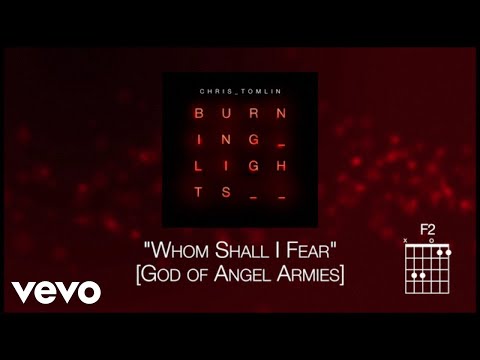 NOT A QUOTE
“Whom Shall I Fear (God of Angel Armies)”
Chris Tomlin
Sing it. Nothing here is presented as scripture. The question is Psalm 27's, the armies are the ones Elisha's servant saw with opened eyes, and the name that carries them comes from a paraphrase Bible's wording, not from this scene.
NOT A QUOTE
“Whom Shall I Fear (God of Angel Armies)”
Chris Tomlin
Sing it. Nothing here is presented as scripture. The question is Psalm 27's, the armies are the ones Elisha's servant saw with opened eyes, and the name that carries them comes from a paraphrase Bible's wording, not from this scene.✓ The scene behind the chorus is real and documented: the writers point to 2 Kings 6, and what the chorus says about presence, always at the singer's side, is verse 16's own point, those with us are more
⚠ No verse is cited and no translation is named, so the lyric gives a singer no road to Psalm 27, 2 Kings 6, or the title's own addresses. The links live in interviews and worship write-ups, not in the song