Psalm 40:5 vs. “Million Little Miracles”
Elevation Worship & Maverick City Music (feat. Joe L. Barnes) · checked 2026-08-21
What we checked
Graded against the standard
Quotation criteria not graded: this song never presents its words as scripture
Applies to every song the Name held holy · God shown holy · true of God · the standard
✓ What's good
- Every item the song counts is credited to God rather than to the singer's own effort, which is the direction Psalm 40:5 runs
- It enumerates. Naming particular things God did is harder and more checkable than a general thanksgiving, and the psalm itself sorts its wonders into named categories rather than one lump
- Nothing is quoted and nothing is presented as scripture, so there is no verse here to misattribute
- God is addressed directly the whole way through, which keeps the gratitude pointed at a person rather than at good fortune
⚠ Cautions
- The publisher's page lists themes but no scripture reference, so any verse a listener hangs on this song is the listener's own. Psalm 40:5 is the nearest text, not a cited one
- Psalm 40:5 counts God's plans as well as His deeds, and counts them "for us". The song's list is retrospective and personal, so the psalm's forward-looking half and its corporate half are both absent
- "Miracle" carries the whole song and is never defined in it. The psalm says wonders and gives two categories to sort them into. Here the listener supplies the definition
- In Psalm 40 the counting is done aloud to an assembly. Sung on headphones, the same total is reached with nobody told
- The section-by-section reading behind the list above comes from one review plus two lyric transcriptions, which agree on what is enumerated but label the sections differently
Verse Proof
Psalm 40:5The text in BSB (Berean Standard Bible)
“Many, O LORD my God, are the wonders You have done, and the plans You have for us— none can compare to You— if I proclaim and declare them, they are more than I can count.”
Psalm 40 carries the heading "For the choirmaster. A Psalm of David," and it begins in a pit. The opening lines describe waiting, being lifted out of the miry clay, having the feet set on a rock and a new song put in the mouth (Psalm 40:1-3, BSB). Verse 5 is where the psalm looks up from that one rescue and tries to take stock of everything. It counts two things, not one: the wonders God has already done, and the plans He has ahead, and the plans are said to be for "us" rather than for the singer alone. The counting is also done out loud. Later in the same psalm the singer says he proclaims righteousness in the great assembly and has not concealed God's faithfulness and salvation from it (Psalm 40:9-10, BSB).
What the song says, described not quoted
A testimony of gratitude, sung in the first person and addressed to God as "You" throughout. The singer looks back across their own life and hands the credit for what they find there upward. The chorus gathers all of it into one figure, a total too large to hold, and the later verses do the actual enumerating: particular things that happened to particular people close to the singer, including a healing, a household changed, comfort after a death, freedom from sin, and ordinary provision. God is never named as Father, Son or Spirit; the address stays general. No verse is cited, quoted or alluded to by reference, and the song never presents any of its words as scripture.
Nothing shifted, because nothing was taken. The song cites no passage, and its publisher's own song page lists themes but no scripture reference for it. What Psalm 40:5 and the song share is one move: an accounting of God's goodness that gives up on the arithmetic. Two things separate them once they sit side by side. The psalm's uncountable total is God's deeds and God's plans for a people, and the song's is a set of events in one life. And the psalm reaches its total while declaring the items to an assembly, where the song reaches its total in remembering. Neither difference makes the song wrong. It makes it a different kind of counting.
▸ Official upload. Now listen with the proof in mind.
Psalm 40 runs out of numbers in the middle of telling somebody. That is where the total came from.
Why it matters
Counting God's goodness until you lose count is a biblical instinct, and Psalm 40:5 is the verse where it happens. What is easy to miss is that the psalm hits that limit in public. Verses 9 and 10 say the singer proclaims righteousness in the great assembly and has not concealed God's faithfulness from it, so the uncountable total is what the declaring produced rather than a reason to skip it. A song that arrives at the same total privately is doing something real and something different in kind, and it helps to know which one is in your mouth.
Is it safe to dwell on?
Sung on repeat, this song moves between God and the singer.
What repetition plants here is the habit of crediting. The chorus is a number, and the number's whole job is to point away from the singer and toward the one being thanked, so singing it on a loop drills in the reflex of assuming a giver behind a good thing. That reflex is healthy and the psalm shares it. The dwelling tag is mixed because the specific content is one person's history rather than God's dealings with His people, so what gets rehearsed is your own life read gratefully. That is a real discipline, and it is not the same discipline as rehearsing what God has done for everyone. If you want both, sing this and then read Psalm 40 through to verse 10, where the counting is carried into the assembly. The private total then has somewhere to go.
Sources
- PraiseCharts — Million Little Miracles · (rights holder's chart page: writers Chris Brown, Steven Furtick and Brandon Lake; CCLI 7171580; publisher line; themes listed and no scripture reference given)
- Wikipedia — Million Little Miracles · (album Old Church Basement, released 30 April 2021, Joe L. Barnes featured; writer credits agree with PraiseCharts)
- Elevation Worship — Million Little Miracles (official upload) · (the recording checked for this proof; oEmbed returns the Elevation Worship channel)
- The Berean Test — Million Little Miracles · (section-by-section reading; the enumerated items are personal circumstances, and the reviewer's own scripture support is James 1:17 and Hebrews 12:2, not Psalm 40)
- Letras — Million Little Miracles · (transcription consulted for section structure and for the direct address to God; no divine person is named)
- BibleHub — Psalm 40 (BSB) · (the psalm's heading, and verses 1-3 and 9-10 quoted in the context section)
Corrections
No corrections to this proof yet.
Think we got something wrong? Tell us what and where, and we will check it against the text. Real errors get fixed here, dated, in public. Every correction on the site →
Where the text survives the song
 ✓ VERIFIED
“Psalm 16”
The Corner Room (Adam Wright)
You can sing this one straight through. It is all eleven verses of Psalm 16, in order, in a named version. What you repeat is the psalm.
✓ VERIFIED
“Psalm 16”
The Corner Room (Adam Wright)
You can sing this one straight through. It is all eleven verses of Psalm 16, in order, in a named version. What you repeat is the psalm.✓ The printed sung text carries all eleven verses of Psalm 16, in order, with no line printed twice and no refrain added
⚠ The track title alone will not tell you which Bible you are singing. On Apple Music and Spotify it is just "Psalm 16". The version is named on the album page and in the video description.
 ✓ VERIFIED
“Psalm 11 (English Standard Version)”
The Corner Room (Adam Wright)
Sing it straight through. It is all seven verses of Psalm 11, in order, in a version the track title names. A reviewer says one verse comes back as a refrain, and it is the psalm's own verse.
✓ VERIFIED
“Psalm 11 (English Standard Version)”
The Corner Room (Adam Wright)
Sing it straight through. It is all seven verses of Psalm 11, in order, in a version the track title names. A reviewer says one verse comes back as a refrain, and it is the psalm's own verse.✓ All seven verses, in order. We set the printed sung text beside an ESV and compared it word by word: 131 words, all matching, nothing added and nothing dropped
⚠ The printed text under the video lists each line once. It is not a map of the song. A review of the album says verse 4 comes back as a refrain
 ✓ VERIFIED
“Psalm 53 (English Standard Version)”
The Corner Room (Adam Wright)
Yes, you can sing it. All six verses of Psalm 53 are here, in order, from a version the release names. The words you repeat are the psalm's own.
✓ VERIFIED
“Psalm 53 (English Standard Version)”
The Corner Room (Adam Wright)
Yes, you can sing it. All six verses of Psalm 53 are here, in order, from a version the release names. The words you repeat are the psalm's own.✓ The printed sung text carries all six verses of Psalm 53, in order, and every one of its 142 words matches an ESV of the psalm
⚠ The printed text is not a transcript. A review of the album calls the psalm's opening line the song's refrain. We did not listen through to count repeats, so that rests on the review
More songs like this
 NOT A QUOTE
“House of the Lord”
Phil Wickham
Sing it. Nothing here is quoting, and the joy it names is real. Just know that Psalm 122's house of the Lord was a place with gates at the end of a road; the song sings that gladness of the gathered church.
NOT A QUOTE
“House of the Lord”
Phil Wickham
Sing it. Nothing here is quoting, and the joy it names is real. Just know that Psalm 122's house of the Lord was a place with gates at the end of a road; the song sings that gladness of the gathered church.✓ Both verses are built from checkable acts of God: a sea parted (Exodus 14), prison doors opened (Acts 16:26), the cross and the empty tomb, and nothing sung of God here is something the text will not support
⚠ Psalm 122's house is a place: one city, real gates, tribes going up by command. The song's house is the gathered people, and the song does not mark the transfer
 NOT A QUOTE
“King of My Heart”
John Mark & Sarah McMillan
Sing it. It names no verse, and what it says of God has scriptural footing. Just hear the bridge the way scripture states it. God does not fail you, which is not the same as nothing going wrong.
NOT A QUOTE
“King of My Heart”
John Mark & Sarah McMillan
Sing it. It names no verse, and what it says of God has scriptural footing. Just hear the bridge the way scripture states it. God does not fail you, which is not the same as nothing going wrong.✓ The chorus states one thing about God and states it plainly, and it is the thing the psalter states most often: the LORD is good. The publisher's own page lists Psalm 100:5 and Psalm 136:1 as the song's references
⚠ Not one of Psalm 62's words appears in the song. If someone tells you this song is Psalm 62, take that as our pairing and their impression, not as a citation
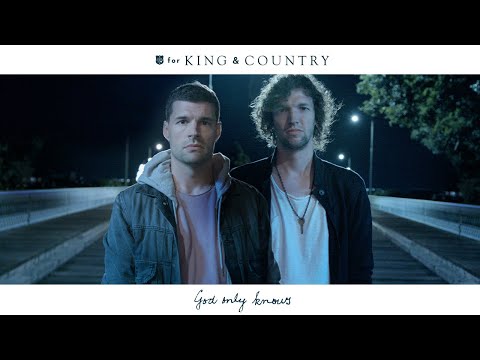 NOT A QUOTE
“God Only Knows”
for KING & COUNTRY
Sing it. It quotes no verse, so hold it as a true sentence about God rather than as scripture. What it says about God knowing you is true, and Psalm 139 is where you can see how far that knowing goes.
NOT A QUOTE
“God Only Knows”
for KING & COUNTRY
Sing it. It quotes no verse, so hold it as a true sentence about God rather than as scripture. What it says about God knowing you is true, and Psalm 139 is where you can see how far that knowing goes.✓ The song's central sentence about God is true and checkable. Psalm 139 says God knows the sitting and the rising, the thought from far off, and the word before it is spoken
⚠ The song stops where the comfort stops. Psalm 139 says the same knowing is inescapable, and the psalm ends by asking God to search the singer and lead him