Jude 1:24-25 vs. “—the keeper (24-25)”
Psallos · checked 2026-08-21
What we checked
Graded against the standard
Quotation criteria this song presents words as scripture, so these apply
Applies to every song the Name held holy · God shown holy · true of God · the standard
✓ What's good
- All four terms of the ascription in verse 25 are present, in the passage's own order, and are given to God rather than described from a distance
- The ground of the doxology is kept intact. God is the one able to keep, and the song never turns the keeping into the listener's work
- Every track on the album is labelled with the verses it covers, so the source of this one is never in doubt
- The images in the opening stanzas come from Jude itself, verses 12 and 13, rather than being imported from elsewhere
- The song poses the doubt it opens with as a question and answers it out of the passage rather than around it
⚠ Cautions
- No translation is named on the album page, the track page or the official upload, so the wording cannot be checked against a stated text. Psallos's own store sells ESV parallel booklets for the Romans and Hebrews albums, and there is no such booklet listed for Jude
- The second half of verse 24, being presented unblemished in God's glorious presence with great joy, is not set. The song keeps the promise of not stumbling and leaves out where the standing ends up
- Verse 25's span, before all time and now and for all eternity, is absent, and so is the description of God as the only God
- Roughly two thirds of the track is the writer's own verse. A listener who knows the song better than the letter may carry the album's images back into these two verses
Verse Proof
Jude 1:24-25The text in BSB (Berean Standard Bible)
“Now to Him who is able to keep you from stumbling and to present you unblemished in His glorious presence, with great joy— to the only God our Savior be glory, majesty, dominion, and authority through Jesus Christ our Lord before all time, and now, and for all eternity. Amen.”
Jude is a single-chapter letter from Jude, a servant of Jesus Christ and brother of James, written to Christians he addresses at the outset as kept for Jesus Christ. Almost the whole of it warns them about teachers who had come into their gatherings quietly, and it draws its warnings from Israel's history, from an angelic dispute over the body of Moses, and from a run of images for the false teachers in verses 12 and 13. Verses 24 and 25 are the letter's final two verses. After twenty-three verses of warning, Jude turns away from the danger and ascribes praise to the God who is able to keep his readers from falling.
What the song says, described not quoted
This is the last of seventeen tracks on an album that works through all twenty-five verses of Jude in order, each track labelled with the verses it covers. It opens by replaying a fragment of spoken testimony from the album's first track, a recorded voice wondering aloud whether God was able to hold on to them. Three short stanzas follow, spoken to the listener, listing the dangers the album has already sung about: the reefs beneath the water, the clouds that promise rain and give none, the wild waves, the stars that give no bearing. Those images come from Jude 12 and 13, not from verses 24 and 25. A fourth stanza then asks four times over, in four different framings, whether God can keep his own from stumbling. Only in the final third does the song reach the doxology. It answers its own question by declaring that God is able to keep, names him Lord, God and Savior, and then turns from the listener to God and gives back the four terms of verse 25, glory and majesty, dominion and authority, through Jesus Christ our Lord, closing on Amen.
The passage is one sentence about God. The song takes that sentence apart and re-aims two of its pieces. The relative clause identifying God as the one who is able becomes first a repeated question put to the listener, then a declaration made to the listener that God is able to keep them. The ascription itself is kept and is voiced to God directly rather than stated about him, which is a change of address the passage does not make. Two clauses of the passage are not set at all: being presented unblemished in his glorious presence with great joy, and the span before all time and now and for all eternity. The word describing him as the only God is also absent. Nothing sung contradicts the passage. A third of it is simply not set, and that space is given to images drawn from earlier in the same letter.
▸ Official upload. Now listen with the proof in mind.
The track is named for two verses and spends most of itself on the twenty-three that come before.
Why it matters
A track titled with a verse reference sets an expectation about what is in it. Here the reference is honest about the source, and roughly two thirds of the song is still not those two verses. That is not a fault in a project of this kind. It is the shape of the form. An album that sets an entire letter has to end somewhere, and its last track carries both the closing verses and the weight of everything sung before them. The habit it asks for is a small one: read the two verses first, then listen for the point where the song begins setting them.
Is it safe to dwell on?
Sung on repeat, this song fixes your attention on God.
What repeats here is a question and then its answer. The song asks four times whether God is able to keep his own from falling, says plainly that he is, and hands the ascription back to him. Sung on a loop that plants God as the keeper and the singer as the kept, which is the direction verse 24 runs. The dwelling tag is God because nearly every line is about what God is able to do, and the listener appears mostly as the one being kept. The one thing repetition will not plant is the half of verse 24 the song leaves out, so the letter's last two verses are worth reading once the track ends.
Helpful comparison
The album does not present itself as a verbatim setting and is not one. Seventeen tracks cover twenty-five verses in order, arranged as a chiasm that mirrors the letter's own structure, with spoken testimony, a courtroom framing device and instrumental writing running between the sung sections. One reviewer describes the result as closer to a play you listen to than to a standard album of songs. Read against that method, this track's proportions are normal for the project rather than a departure from it. The mix is the point: interpretive verse that carries the album's argument, then a close setting of the words the letter ends on.
The writer's own verse in the first two thirds is built from Jude 12 and 13, so it is drawn from the same letter even though it is not the passage. No translation is named on the album's own pages or on the official upload.
Sources
- Psallos — “—the keeper (24-25)” on Bandcamp · (the recording checked for this proof; track page for the album's closing song)
- Psallos — Jude on Bandcamp · (seventeen tracks, each labelled with its verse span, closing with verses 24-25; released 19 June 2019; words and music by Cody Curtis, lead vocals Thomas Griffith and Kelsie Edgren)
- Psallos — Jude album page · (the artist's own page: music, lyrics, orchestration and production by Cody Curtis; no translation named)
- Psallos — “—the keeper (Jude 24-25)” official upload · (Psallos Music channel; description names the composer and the copyright holder, no translation)
- Art & Theology — Album Review: Jude by Psallos · (the album as a half-hour journey through all twenty-five verses; chiastic structure, spoken testimony and courtroom framing; track titles drawn from the ESV of Jude 12 and 13; the closing doxology addressed to the keeper)
- Jesusfreakhideout — Psallos, “Jude” review · (independent release; the album described as closer to a play than a standard concept album, with tracks that do not function as conventional songs; gives the release date as 27 June 2019, against Bandcamp's 19 June)
- Psallos store — Hebrews ESV Lyric E-Booklet · (Psallos's own product: the ESV text of Hebrews in one column with the song lyrics parallel to it, showing the version the project works from on its other albums)
Corrections
No corrections to this proof yet.
Think we got something wrong? Tell us what and where, and we will check it against the text. Real errors get fixed here, dated, in public. Every correction on the site →
Where the text survives the song
 ✓ VERIFIED
“Proverbs 4”
Streetlights
Play it freely. This is Proverbs 4 itself, read word for word in a named translation. “Guard your heart” arrives with the commands about the mouth, the eyes and the feet still attached.
✓ VERIFIED
“Proverbs 4”
Streetlights
Play it freely. This is Proverbs 4 itself, read word for word in a named translation. “Guard your heart” arrives with the commands about the mouth, the eyes and the feet still attached.✓ The whole chapter, in order, so “guard your heart” arrives with the commands about the mouth, the eyes and the feet, instead of standing alone as advice
⚠ “Word-for-word” here describes the reading, not the translation theory. Streetlights uses it for what is read. Tyndale uses the same phrase for a different thing
 ✓ VERIFIED
“Psalm 11 (English Standard Version)”
The Corner Room (Adam Wright)
Sing it straight through. It is all seven verses of Psalm 11, in order, in a version the track title names. A reviewer says one verse comes back as a refrain, and it is the psalm's own verse.
✓ VERIFIED
“Psalm 11 (English Standard Version)”
The Corner Room (Adam Wright)
Sing it straight through. It is all seven verses of Psalm 11, in order, in a version the track title names. A reviewer says one verse comes back as a refrain, and it is the psalm's own verse.✓ All seven verses, in order. We set the printed sung text beside an ESV and compared it word by word: 131 words, all matching, nothing added and nothing dropped
⚠ The printed text under the video lists each line once. It is not a map of the song. A review of the album says verse 4 comes back as a refrain
 ✓ VERIFIED
“Walk In Him (Colossians 2:6-7)”
Seeds Kids Worship (Seeds Family Worship)
Sing it, and teach it. The whole sentence arrives, in order, in the version Seeds names. Read verse 8 afterward, so a child knows what the walking is set against.
✓ VERIFIED
“Walk In Him (Colossians 2:6-7)”
Seeds Kids Worship (Seeds Family Worship)
Sing it, and teach it. The whole sentence arrives, in order, in the version Seeds names. Read verse 8 afterward, so a child knows what the walking is set against.✓ Every word the chord chart prints as lyric is a word of Colossians 2:6-7, in the passage's order, and no word of the passage is left out.
✓ no cautions: this is the standard
More songs like this
 ~ FAITHFUL
“Just As I Am”
Charlotte Elliott (recorded by Reawaken Hymns)
Sing it. The clause it was printed under is quoted accurately, and the hymn answers that clause honestly. Read the whole verse once. The half the hymn leaves out is the half that makes the half it sings hold.
~ FAITHFUL
“Just As I Am”
Charlotte Elliott (recorded by Reawaken Hymns)
Sing it. The clause it was printed under is quoted accurately, and the hymn answers that clause honestly. Read the whole verse once. The half the hymn leaves out is the half that makes the half it sings hold.✓ The epigraph is a real citation, printed with the hymn at its first confirmed publication, and its clause is quoted word for word.
⚠ The epigraph names the address and not the version. Its wording is King James (KJV); a singer who looks the verse up in a modern Bible will find different words for the same clause.
 ~ FAITHFUL
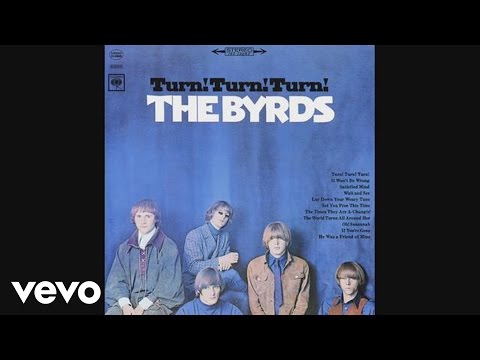
“Turn! Turn! Turn! (To Everything There Is a Season)”
The Byrds
Sing it. Almost every word is Ecclesiastes 3:1-8 in King James English. Know that the order is the songwriter's, and that the last line is his own rather than the Preacher's.
~ FAITHFUL
“Turn! Turn! Turn! (To Everything There Is a Season)”
The Byrds
Sing it. Almost every word is Ecclesiastes 3:1-8 in King James English. Know that the order is the songwriter's, and that the last line is his own rather than the Preacher's.✓ Almost every sung word is Ecclesiastes 3:1-8 itself, in King James wording, with the pairs carried whole rather than paraphrased into something looser
⚠ The pairs are sung in a different order from the chapter's, and nothing in the song signals that the order changed
 ~ FAITHFUL
“Psalm 100”
Poor Bishop Hooper
Sing it. It is all five verses of Psalm 100 with nothing added. Just know the order has been rebuilt: the psalm ends on God's goodness and faithfulness, and the song ends on our belonging to Him.
~ FAITHFUL
“Psalm 100”
Poor Bishop Hooper
Sing it. It is all five verses of Psalm 100 with nothing added. Just know the order has been rebuilt: the psalm ends on God's goodness and faithfulness, and the song ends on our belonging to Him.✓ Every clause of all five verses is present, and no line in the song comes from outside Psalm 100
⚠ No translation is named anywhere on the release, the project pages, or the upload, so the wording cannot be checked against a source the listener is pointed to