Psalm 8:3-4 vs. “How Great Thou Art”
Carrie Underwood · checked 2026-08-01
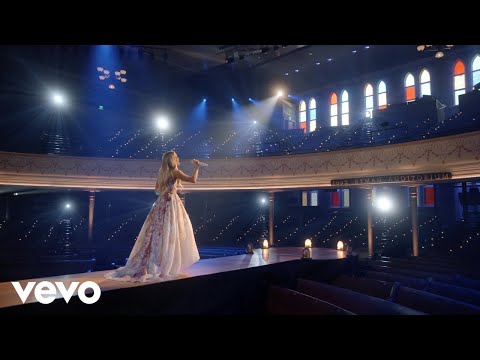
▸ Official upload. Listen with the bottom line in mind. The evidence is below.
Verse Proof
Psalm 8:3-4The text in BSB (Berean Standard Bible)
“When I behold Your heavens, the work of Your fingers, the moon and the stars, which You have set in place— what is man that You are mindful of him, or the son of man that You care for him?”
Psalm 8 is a psalm of David, addressed to God from the first line to the last, and it opens and closes with the same sentence about the majesty of God's name in all the earth. Verses 3 and 4 are the hinge. The psalmist looks up at a night sky God arranged and then asks why God should give any attention to something as small as a man. The question does not stay open. Verses 5 and 6 answer it: God made man a little lower than the heavenly beings, crowned him with glory and honour, and put the works of God's hands under his feet. So the passage runs sky, then smallness, then the dignity God gave anyway.
What the song says, described not quoted
The stanza that echoes this passage has the singer standing in wonder at the worlds God made, at the stars, at thunder, at power on display across the universe. The refrain answers with the singer's soul praising God and saying how great God is. A later stanza turns from creation to the cross and the Son God sent to bear sin. The last one looks ahead to Christ's return and the singer being taken home. No verse is quoted anywhere in the hymn, and no reference is given.
Nothing shifted at the level of wording, because no wording is presented as scripture. What is missing is the second half of the psalm's move. Psalm 8:3-4 looks at the sky and then asks about man. The hymn looks at the sky and then sings about God. Both are true responses to the same view, and only one of them is Psalm 8's. There is a second thing worth attributing, which is the words themselves. Carl Boberg wrote a Swedish poem of nine stanzas in 1885. Manfred von Glehn made a German version, and Ivan S. Prokhanoff made a Russian one. The sources disagree on which came first. Stuart K. Hine made the English in 1949, inspired by the Russian: Wikipedia calls it a loose translation, and the Hymnology Archive calls it inspired by the Russian rather than translated from it. By Hine's own account, two of its four stanzas are his own writing. Not one step in that chain was a translation of the Bible.
✓ What's good
- Never says it is quoting, anywhere. No verse cited, no scripture framing, nothing presented as the Bible's words
- The refrain and the stanzas are mostly about God: His works, His Son, His return. The singer is present as the one looking, and the last stanza looks ahead to being taken home
- The opening keeps the psalm's actual starting move, standing under a sky God arranged and answering it out loud
- Its authorship is documented in unusual detail and credited to Boberg and Hine both, so the chain can be traced by anyone who wants to, though the sources differ on its order
⚠ Cautions
- Hymnary's scripture note ties it to Psalm 8 as a "see also", but the hymn never cites the psalm. The link is a resemblance someone else noticed, not something the hymn says
- Psalm 8:4 asks what man is that God is mindful of him. The hymn moves from the sky straight to praise, so singing it does not teach the psalm's turn
- The psalm answers its own question in verses 5 and 6, with the honour God gave to man. The hymn answers with the cross instead. That is true, and it is not what Psalm 8 says
- The English words came by way of a Russian version. The Hymnology Archive calls them inspired by it rather than translated from it, and two of the four stanzas are Hine's own writing. Treating the hymn as Boberg's poem in English is a few steps off
- A literal English translation of Boberg does exist, E. Gustav Johnson's "O Mighty God" of 1925, and it is not the one anybody sings
How we checked it
Graded against the standard
Quotation criteria not graded: this song never presents its words as scripture
Applies to every song God's name honored · God shown as holy · nothing untrue of God · the standard
The hymn everyone knows reached English by way of other languages, with two stanzas nobody translated at all.
Why it matters
This is one of the most sung hymns in English, and Hymnary's scripture note ties it to Psalm 8 as a "see also". That note is somebody's description of a resemblance. It is not a citation the hymn makes about itself, and the difference is easy to miss when the two are printed on the same page.
The distinction matters because of how the words got here. The English text people sing reached them through other people and other languages, and half its stanzas were never Boberg's at all. None of that is dishonest and none of it is hidden. It is simply worth knowing before treating a hymn as though it were the psalm in singable form.
Is it safe to dwell on?
Sung on repeat, this song fixes your attention on God.
The most repeated part of this hymn is the refrain, and the refrain is addressed to God about God. That is what looping it plants: the reflex of looking up at something large and then speaking to the One who made it, rather than about yourself. The stanzas keep widening the same view, from stars to the cross to Christ's return, so the picture of God that repetition builds here is a big one and it stays big.
What repetition will not plant is Psalm 8's question. The psalm makes you stand under the sky and feel small before it tells you what God did about that. The hymn skips from the sky to praise, which is a fair thing for a hymn to do and leaves a gap worth filling on purpose. If you sing this often, read the psalm through to verse 6 sometimes, so the awe you have rehearsed lands where David put it.
Helpful comparison
The chain is the checkable part, and the arithmetic is worth laying out. Boberg's Swedish poem had nine stanzas, published on the front page of Mönsterås Tidningen on 13 March 1886. Von Glehn's German version carried six of them. Prokhanoff's Russian version ran to eight and reordered two. Hine's English has four, and by the accounts of his own booklet the third and fourth are his composition rather than anyone's translation. Sources disagree about the years of the German and Russian versions, and so about which came first, which is itself a small lesson in how much of this history is reconstructed.
Two details sharpen the point. First, the Hymnology Archive describes Hine's text as inspired by the Russian rather than translated from it, and Hymnary's notes say much of Boberg's original was lost along the way. Second, the one scriptural quotation in the Hymnology Archive's account sits at the head of the Russian version, and it is Psalm 19:1, numbered 18:2 in the Russian Bible. The closest thing to a citation in the hymn's whole history points at a different psalm from the Psalm 8 that Hymnary's note ties the English text to. The hymnologist Carl P. Daw Jr. calls the English text "a post-Romantic Christianizing of Psalm 8," which is a description of what Hine made, and a good reason not to read it as what David wrote.
Sources
- Carrie Underwood: How Great Thou Art (Official Performance Video) · (the recording checked for this proof; carrieunderwoodVEVO, from My Savior: Live from the Ryman)
- Wikipedia: My Savior (album) · (album, release date of 26 March 2021, Capitol Nashville, "How Great Thou Art" as a solo track credited to Boberg and Hine)
- Wikipedia: How Great Thou Art · (Boberg 1885, von Glehn's German, Prokhanoff's Russian, Hine's 1949 loose translation from the Russian, third and fourth stanzas Hine's own, E. Gustav Johnson's 1925 "O Mighty God")
- Hymnology Archive: How Great Thou Art · (nine Swedish stanzas published 13 March 1886; six in German, eight in Russian with two reordered, and the order and years of the German and Russian debated; Hine inspired by rather than translating the Russian; his 1958 booklet; the Psalm 19:1 quotation at the head of the Russian version; Carl P. Daw Jr.'s assessment)
- Hymnary.org: How Great Thou Art · (credits; a scripture note that lists Psalm 8 as a "see also"; and the note that much of Boberg's original was lost through the successive translations)
Corrections
- This entry stated the Swedish, German, Russian, English chain as settled fact, but its own sources disagree on the order and years of the German and Russian versions, and the Hymnology Archive calls Hine's text inspired by the Russian rather than translated from it. It also said hymnals routinely index the hymn under Psalm 8, which rests on one Hymnary note that lists Psalm 8 as "see also", and said nothing it says about God is contradicted by Psalm 8, which no source supports. The chain is now stated with the uncertainty, the indexing claim is weaker, the absolute is removed, and the bottom line no longer says the hymn "cannot support" a scripture claim. The finding is unchanged.
Think we got something wrong? Tell us what and where, and we will check it against the text. Real errors get fixed here, dated, in public. Every correction on the site →
Where the text survives the song
 ✓ VERIFIED
“Wonderful”
Seeds Kids Worship (Seeds Family Worship)
Sing it, and hand it to your kids. It is one verse of Psalm 139, word for word in a translation named on the label, so what they memorize is the verse.
✓ One verse, word for word: nothing added, dropped, or reordered
✓ No cautions
 ✓ VERIFIED
“Psalm 11 (English Standard Version)”
The Corner Room (Adam Wright)
Sing it straight through. It is all seven verses of Psalm 11, in order, in a version the track title names. A reviewer says one verse comes back as a refrain, and it is the psalm's own verse.
✓ All seven verses, in order. We set the printed sung text beside an ESV and compared it word by word: 131 words, all matching, nothing added and nothing dropped
⚠ The printed text under the video lists each line once. It is not a map of the song. A review of the album says verse 4 comes back as a refrain
 ✓ VERIFIED
“Psalm 16”
The Corner Room (Adam Wright)
You can sing this one straight through. It is all eleven verses of Psalm 16, in order, in a named version. What you repeat is the psalm.
✓ The printed sung text carries all eleven verses of Psalm 16, in order, with no line printed twice and no refrain added
⚠ The track title alone will not tell you which Bible you are singing. On Apple Music and Spotify it is just "Psalm 16". The version is named on the album page and in the video description.
More songs like this
 NOT A QUOTE
“Blessed Assurance”
Carrie Underwood
Sing it as what it says it is, a testimony. It names no verse, and what it says of God is what scripture says. Just let Hebrews, not the feeling, define what holds assurance up.
✓ The first stanza grounds its confidence in God's acts, purchase, new birth by the Spirit, washing in His blood, before any experience is described. The testimony rests on doctrine first
⚠ The later stanzas measure the assured life in experiences: completed surrender, visions, rest. Hebrews 10:22 asks for none of that, and a singer who lacks the visions has lost nothing the verse promises
 NOT A QUOTE
“Nothing But the Blood of Jesus”
Carrie Underwood
Sing it. Nothing in it is quoting. The question-and-answer refrain compresses Hebrews 9 and 10 in the direction the chapters themselves run, from the law's rule about blood to the blood of Jesus alone.
✓ The 1876 publication printed its source text underneath the title, Hebrews 9:22, which is the citation habit this site exists to encourage
⚠ The blood in Hebrews 9:22 is the law's animal blood. The step to Jesus' blood alone is the argument of the surrounding chapters, not of the verse under the title
 NOT A QUOTE
“God Only Knows”
for KING & COUNTRY
Sing it. It quotes no verse, so hold it as a true sentence about God rather than as scripture. What it says about God knowing you is true, and Psalm 139 is where you can see how far that knowing goes.
✓ The song's central sentence about God is true and checkable. Psalm 139 says God knows the sitting and the rising, the thought from far off, and the word before it is spoken
⚠ The song stops where the comfort stops. Psalm 139 says the same knowing is inescapable, and the psalm ends by asking God to search the singer and lead him