ActualChristianMusic

A timeline of Christian music

Contemporary Christian music, and the worship songs churches sing, told as time capsules. Open a year. See what was happening, and which songs from that moment this site has checked.

A capsule is one moment. The year comes first. Under the story are songs from that moment this site has already checked. Under those are our sources. When two sources disagree, the capsule says so. A song we have not checked does not appear here as if we had.

This site has 263 proofs. 227 name a year from 2000 on. 32 name an earlier year. 4 name no year. Most songs checked here are recent worship songs. This page starts earlier, in 1951.

Watch

How Contemporary Christian Music Shaped American Culture Holy Post Media · 11 min The Holy Post team walks through Christian music from the 1970s to the early 2000s, from Keith Green to DC Talk, and how it was marketed.

Watch

Dr Leah Payne: The Complicated History of Christian Pop Music Christian Education National · 54 min Historian Leah Payne talks about the history of Christian pop music and the business around it.

Videos on this page are other people's. Their views are their own and may not reflect ours. Each one plays here when you press it.

The trade

1951 to 1969

Years before the Jesus music of the 1970s, a company in Waco was already shipping records and sheet music, and the gospel music trade had started an award.

1951

Institution

Word Records starts in Waco

Jarrell McCracken started Word Records in Waco, Texas, in 1951. He studied at Baylor University there. Waco History, Baylor and Christianity Today all date it to 1951.

It began with one spoken record, The Game of Life. People who heard it asked for copies. Waco History says he paid to press one hundred.

Baylor says a friend suggested the name WORD, after the made-up radio station in the recording.

Waco History says two friends, Henry Sorelle and Ted Snider, helped him run the company. Wikipedia spells the first name SoRelle and calls both men co-founders. This page does not settle the spelling.

Word sold more than records. Waco History lists sheet music, Christian literature and teaching resources. A label history from Both Sides Now says Word opened Word Books in the 1960s and signed Billy Graham.

Kurt Kaiser joined in 1959 as Director of Artists and Repertoire, the person who chooses the artists and songs. In 1960 Word moved into a building made for it on West Waco Drive.

Word started its own labels. Both Sides Now says Canaan began in the 1960s. Baylor says Billy Ray Hearn started Myrrh at Word in Waco in 1972, one of the first labels for contemporary Christian music. Waco History calls both labels acquisitions. The other sources say Word started them.

Word was sold to the American Broadcasting Company in 1974. Word's own later press release says ABC bought part interest. McCracken's family says ABC agreed to keep Word in Waco.

Waco History says ABC eventually moved the company near Fort Worth. In 1992 Thomas Nelson agreed to buy Word, Christianity Today reported. In the 1990s Word was in Nashville, where Nashville Sites places it on Music Row.

What it was like

Waco History shows workers in Waco preparing record shipments by hand. It credits the photo to a 1974 Waco Tribune-Herald piece titled “World's Largest Producer of Religious Records.”

Both Sides Now says that for most of the 1960s through the 1980s, Word was the “distributor of choice to Christian bookstores.” Waco History says Word gave jobs to many Baylor students.

Why it is here

A company in Waco was recording, publishing and shipping Christian music, and for much of the 1960s to the 1980s it was the distributor of choice to Christian bookstores.

Myrrh started inside Word in 1972. Age to Age, a Myrrh album, is checked on this site.
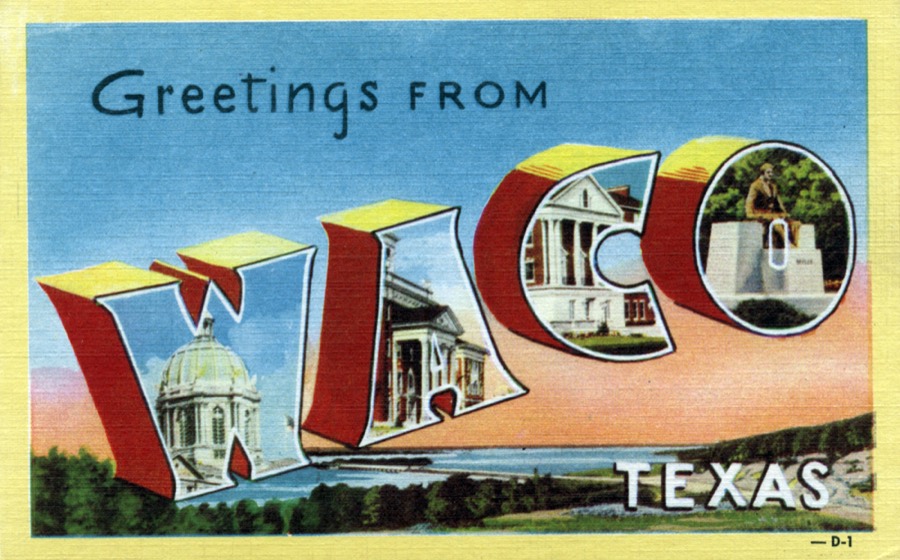
A large-letter postcard reading Greetings from Waco, Texas, with scenes of the city inside the letters.
Waco around 1950, about when Word began. A postcard of the city, not of Word. Steve Shook, “Greetings from Waco, Texas - Large Letter Postcard”, CC BY 2.0, via Wikimedia Commons

Where it was

  • McCracken's apartment Waco, address not known Waco History says he first ran Word from his apartment.
  • Franklin Avenue, downtown Franklin Ave., Waco, street number not found The Baylor Lariat calls it the company's original building. A Waco History recording about the move to West Waco Drive mentions Franklin Avenue. Baylor Proud calls the first building downtown. Map ↗
  • 4800 West Waco Drive 4800 W. Waco Dr., Waco, Texas Word's building from 1960, designed for the label, with a W-shaped roofline (Waco History). Roadside Architecture links a street view of the “former Word Records Incorporated” at about this spot. Today it is marketed as Word Office Suites, an office building with suites for lease. That listing gives 1964 as the year built, while Waco History dates Word's move there to 1960. Map ↗
  • Baylor University Waco, TX McCracken earned a BA in 1950 and an MA in 1953 there. Billy Ray Hearn, who started Myrrh at Word, was a Baylor alum, and Word hired many Baylor students. Map ↗

Pictures elsewhere

Hear it

El Shaddai Amy Grant The official upload. Our check against Exodus 6:2-3: NOT A QUOTE.

Watch

The Bizarre Evolution of Christian Music Labels Jonathan Allen Wright · 19 min This episode tells how Word Records and Sparrow Records began, and how Christian record labels grew.

Checked on this site

  • El Shaddai Amy Grant Exodus 6:2-3 · NOT A QUOTE
Sources · 13

1964 to 1969

Institution

The Dove Awards begin

The Gospel Music Association says it was founded in 1964.

Its Dove Awards page says the first show was in 1969. It was a small gathering at the Peabody Hotel in Memphis, to award that year's work in Southern Gospel.

The page says Bob McConnell, then art director at Benson Records, was one of the planners. It says Les Beesley of the Florida Boys proposed the name Dove Awards at a lunch. That is the spelling on the page.

The page lists the first recipient as Dwayne Friend, Best Gospel Instrumentalist, 1969.

What it was like

The page calls the first show a small gathering.

Why it is here

The trade had its own award while the show, on that page's account, was still for Southern Gospel.

Later capsules sit in a world this association already existed to honor.

Sources · 2

Jesus music

1971 to 1972

Young people were bringing new songs into church. A label formed to promote them. A big conference put the music on one stage. One of the songs was a Bible verse.

1971

Institution

Maranatha! Music starts

Maranatha! Music says it was founded in 1971 by Chuck Smith Sr. of Calvary Chapel.

The label's own history says the point was to put out the Jesus music young people at that church were writing and singing.

The same page says the songs were then considered unsuitable for the traditional church.

What it was like

The page says the label was founded to promote those songs.

Why it is here

The page calls Maranatha! Music a pioneer in praise and worship music publishing.

The words still have to be checked one song at a time. The next capsule is one of those songs.

Hear it

Seek Ye First Karen Lafferty The official upload. Our check against Matthew 6:31-33: ~ FAITHFUL.

Watch

They Burned Records...Then Started Making Them | Untold History of CCM Jonathan Allen Wright · 26 min The series starts with church singing after the Reformation and follows the hymn writers up to the arrival of rock and roll.

Checked on this site

Sources · 1

1971 to 1972

Song

Seek Ye First is a Bible verse, then a record

Hymnary says Karen Lafferty wrote this song in 1971, after a Bible study on Matthew 6:33 at Calvary Chapel in Costa Mesa.

It says Maranatha! Music published it in 1972 on the label's first praise album.

Hymnary also says the other stanzas are anonymous. It ties one to Matthew 7:7 and one to Matthew 4:4.

What it was like

Hymnary says the song soon gained popularity, and that the other stanzas were written by people who are not named.

Why it is here

This site has checked the song against Matthew 6:31-33. The proof is the place to see what matches and what the other stanzas add.

The timeline does not regrade it. The proof does.

Hear it

Seek Ye First Karen Lafferty The official upload. Our check against Matthew 6:31-33: ~ FAITHFUL.

Checked on this site

Sources · 1
  • Hymnary, “Seek ye first the kingdom of God”. Says Lafferty wrote it in 1971 after a Bible study on Matthew 6:33 at Calvary Chapel, Costa Mesa, and that Maranatha published it in 1972 on their first praise album. Later stanzas are anonymous.

1972

Moment

Explo 72 fills the Cotton Bowl

Campus Crusade for Christ, now called Cru, held a conference named Explo 72 in Dallas.

A report printed on July 1, 1972 says the conference ran from June 12 to June 17. It says 70,464 people were in the Cotton Bowl on June 13, the first night. The same issue's cover caption says some 75,000 at the first evening session, and its headline refers to 85,000 others who experienced it. It names Campus Crusade as the sponsor, and Andraé Crouch and the Disciples among the musicians.

Christianity Today, in July 1972, calls it a five-day meeting in Dallas the month before. It says 75,000 people registered, and about 10,000 more visited. That was short of a goal of 100,000. It says the Cotton Bowl filled four nights. It says the meeting ended with a Jesus music festival that police and newspaper estimates put between 120,000 and 180,000.

That report names Love Song, Andraé Crouch and the Disciples, and Katie Henley among the musicians. It names Paul Eshleman as director, Bill Bright as the leader of Campus Crusade, and Billy Graham as honorary chairman.

Cru's later history says more than 80,000 college and high school students came to the Cotton Bowl in 1972. It names Bill Bright and Billy Graham as teachers, and Love Song and Andraé Crouch and the Disciples among the musicians. It does not separate a closing festival. The reports also count the days differently: five days in one, June 12 to June 17 in another.

These are not the same kind of number. One is a first night. One is a registration total. One is a closing festival. One is a later summary of the week. This page does not add them into one total.

Cru says the press referred to the event as the Christian Woodstock. That phrase is the press's, not a finding of this site.

What it was like

Cru names teachers and musicians together.

Why it is here

The songs and the event traveled together. The reports name groups. They do not give a full set list.

Two Crouch songs are already checked here. They are listed because they are his, and because this site has checked them. They are not a set list for the Cotton Bowl.

Hear it

My Tribute (To God Be the Glory) Andraé Crouch & The Disciples The official upload. Our check against Psalm 115:1: NOT A QUOTE.

Watch

The Untold Tragedy Behind the Jesus Movement? Jonathan Allen Wright · 22 min This episode tells the story of the Jesus Movement, from Lonnie Frisbee to Larry Norman and Maranatha Music.

Checked on this site

Sources · 3
  • The Sabbath Recorder, July 1, 1972. A report from the month of the conference. Counts 70,464 at the first Cotton Bowl rally on June 13, dates the week June 12 to 17, and names Campus Crusade and Andraé Crouch and the Disciples.
  • Cru, “What really happened at Explo ’72”. The organizer's later account. Says more than 80,000 students, the Cotton Bowl, Dallas, 1972, and names the teachers and musicians above. Says the press called it the Christian Woodstock.
  • Edward E. Plowman, Christianity Today, July 1972. A report from the month after the meeting. Gives the registration count, the visitor count, the four Cotton Bowl nights, the festival estimates, and the names of the director and the musicians.

A business, and a license

1982 on

A Christian album was certified gold, then platinum. Churches that copied songs onto screens needed a license. The public list of top songs is not one list.

1982

Album

Age to Age goes gold, then platinum

The Tennessee Arts Commission says Age to Age is a 1982 album.

It says the album was the first Christian album by a solo artist to be certified gold, in 1983. It says the same album was the first Christian album certified platinum, in 1985.

The RIAA Gold and Platinum search, opened for this album, shows one row. The label is Myrrh. The format is album. The date is June 24, 1985. The award name, gold or platinum, was not in the table text. It showed no 1983 row.

The gold year and the word platinum are the commission's. The June 24, 1985 date and the Myrrh label are on the RIAA row.

What it was like

The commission's point is the sales award: Age to Age was certified gold, then platinum.

Why it is here

Once the music was a business at that size, the songs were no longer only what one church wrote for itself. They were releases.

El Shaddai is on that album. This site has checked it against Exodus 6:2-3.

Hear it

El Shaddai Amy Grant The official upload. Our check against Exodus 6:2-3: NOT A QUOTE.

Watch

Amy Grant, Pop Stars & the Industry That Trapped Them? Jonathan Allen Wright · 25 min This episode traces how CCM grew into a big business, from gospel pioneers to pop stars like Amy Grant, and how record deals work.

Checked on this site

  • El Shaddai Amy Grant Exodus 6:2-3 · NOT A QUOTE
Sources · 2

1985 to 1987

Institution

Hosanna carries songs from church to church

An archived copy of Integrity Music's about page says that in 1985 a small group went from church to church to introduce worship leaders, and the songs of one church, to the next.

It says that collection of records became Integrity's Hosanna Music, with a publishing imprint. It says Integrity Music was officially formed in 1987.

The page names Give Thanks among the songs in what it calls the cornerstone of Integrity Music. It also names later songs. It does not say they all date from 1985.

What it was like

The company's account is that the records were made by carrying songs from one church to another.

Why it is here

Records carried between churches were one way a new congregational song traveled.

This site has checked Give Thanks. The proof is of the song. It is not a claim that the recording we checked is the 1985 tape.

Hear it

Give Thanks Henry Smith (recorded by Don Moen) The official upload. Our check against 2 Corinthians 8:9: NOT A QUOTE.

Watch

Dr Adam Perez The Origins of Contemporary Praise and Worship Music Theologische Hochschule Reutlingen · 1 h 9 min Dr. Adam Perez traces one of the two main roots of modern praise and worship music.

Checked on this site

  • Give Thanks Henry Smith (recorded by Don Moen) 2 Corinthians 8:9 · NOT A QUOTE
Sources · 1

1984 to 1988

Institution

CCLI licenses the words on the screen

In 1984 a pastor in Portland, Oregon, read about a copyright lawsuit against the Archdiocese in Chicago. CCLI's own history says the suit was for $3.1 million. The pastor asked his music minister, Howard Rachinski, whether their church was copying songs lawfully.

Rachinski says the church had 400 song transparencies. Those are the clear sheets a church laid on an overhead projector. He says permission for the sheets they already had would have cost about $6,000.

He started a ministry called StarPraise. In May 1985, at a conference, 25 churches signed up for a yearly license. The fee was $75.

In 1988 that ministry became a company. CCLI's page says it was incorporated that year as Christian Copyright Licensing, Inc. Rachinski says the license launched in the United States in October 1988, with songs from 120 publishers. He says 1,600 churches were already using it.

The company's page now says CCLI serves more than 230,000 churches and organizations worldwide. Rachinski's page says 250,000 churches in 70 countries. The two numbers do not match. This page does not average them.

A church with the license is asked to report the songs it copies or reproduces. CCLI says those reports are how it pays the songwriters and publishers. The form also asks when a song was used in a service. A report is what a church sends in. It is not a count of every congregation that sang.

What it was like

Before the license, a leader who wanted a new song on a screen had to ask each publisher, or copy the song with no permission. After it, one fee covered a catalog. The copy was supposed to be reported.

Why it is here

The words a church sings got tied to a license, a report, and a payment. CCLI says its license covers churches that copy or reproduce songs, and that it relies on those reports to pay songwriters and publishers.

The report can tell you what was copied. It cannot, by itself, tell you that the words match the Bible.

Watch

CCLI Explained in 3 Minutes (For Church Musicians) + FREE Access To Public Domain Chord Charts thechurchpianoplayer · 5 min A three-minute guide for church musicians on what CCLI is and how to use its website to find songs.
Sources · 3
  • CCLI, “Our History”. Says the 1984 lawsuit figure, the 1988 incorporation as Christian Copyright Licensing, Inc., and that CCLI now serves more than 230,000 churches and organizations.
  • Howard Rachinski, about page. His account of the 400 transparencies, the $6,000 figure, StarPraise in May 1985, and the October 1988 launch with 120 publishers and 1,600 churches. His page says 250,000 churches in 70 countries.
  • CCLI, reporting. Says reporting is how CCLI pays songwriters and publishers for songs the license lets a church copy or reproduce, and that churches also report use in services.

1993

Technology

SongSelect puts the lyric on a disk

Rachinski says that in 1993 CCLI launched SongSelect. He says it shipped floppy disks with lyrics for 6,000 songs, and software a church could use to plan a service.

He says that in 2002 the same service moved online, so a church could download lyrics and charts.

This is his account. CCLI's public history page, as opened for the capsule above, does not retell the 1993 launch.

What it was like

He says a church could plan a service from those disks, and later download the lyric and the chart.

Why it is here

A downloaded lyric is easy to trust and easy not to check. The check is still the passage.

Sources · 1
  • Howard Rachinski, about page. Says SongSelect launched in 1993 on floppy disks with lyrics for 6,000 songs, and moved to online downloads in 2002.

2020 and 2026

Technology

Two lists can both be called the top 100

SongSelect's own page calls the CCLI Top 100 the list of top songs reported by licensed churches of many denominations and sizes.

It says the database holds 260,000 worship songs and hymns. It says churches that hold the copyright license get the lyrics free.

CCLI's page for Southern Baptist churches, opened the same day, describes three lists. One is songs reported by Southern Baptist license holders. One is this week's U.S. top 100, based on SongSelect downloads. One is the most reported songs from license holders in the United States, updated quarterly.

A Christianity Today article on June 12, 2020 still described the Top 100 as ranked by use in churches.

The two CCLI pages describe the CCLI Top 100 differently. A sentence about the top songs has to say which list it means.

What it was like

A license holder on SongSelect is downloading a lyric or a chart, or pulling the lyric into the software that runs the screens. That is what the SongSelect page says the tool does.

Why it is here

In 2020, Christianity Today described the Top 100 as ranked by use in churches.

A download chart and a reported-use chart can now both be called a top 100. Copying is still not a check against the text.

Watch

The Worship Tax - How your church's worship profits secular investors via CCLI Selling Jesus · 19 min Selling Jesus looks at the fees CCLI charges churches to use worship songs, and at songs being sold to investors.
Sources · 3
  • CCLI, SongSelect. Calls the Top 100 a list reported by licensed churches, and says the database holds 260,000 songs and that license holders get lyrics free.
  • CCLI, Southern Baptist resources. Describes three lists: songs reported by Southern Baptist churches, a weekly U.S. top 100 based on SongSelect downloads, and a quarterly list of the most reported songs.
  • Megan Fowler, Christianity Today, June 12, 2020. Describes the CCLI Top 100, in 2020, as ranked by use in churches.

Songs that traveled

1997 to 2020

Student conferences, a Sydney album, and a song from Lagos each became something churches far away were singing. The path was a recording, a license, or a radio chart.

1995 to 1997

Moment

Passion gathers students in Austin

Passion's own page says the movement started in 1995 and the first gathering was in 1997.

It names Louie Giglio as the visionary and Shelley Giglio as co-founder. It names sixstepsrecords as part of the work. It points to Isaiah 26:8. This page does not quote the verse.

CCM Magazine, on January 16, 2017, says two thousand college students attended the first conference, in Austin, Texas, in January 1997.

What it was like

The magazine's sentence is a student gathering. It is not a count of how many churches sang the songs the next Sunday.

Why it is here

Passion's page ties the movement to worship, and the 1997 gathering was for students. This page does not say what was sung.

This page does not list the 1997 set. The songs still have to be checked one at a time.

Sources · 2

2013

Song

Oceans, from the album Zion

Hillsong's page for Zion (Deluxe Edition) is dated 2013. Oceans (Where Feet May Fail) is track 4.

A Gospel Music Association news post dated December 19, 2014 says the song had received RIAA platinum status. It calls Zion the group's 2013 album.

It says Oceans was the group's first No. 1 radio single. It says the song cracked “the longest reign” on Billboard's Hot Christian Songs chart. This is a press release. It does not give the number of weeks.

The same post says United rose out of the youth ministry of Hillsong Church in Sydney, and that the group released a first album in 1999. The RIAA database was not opened for this title.

What it was like

The announcement is about radio, a sales award, and a video count. It does not say how many churches sang the song.

Why it is here

A song from Hillsong United became a No. 1 radio single and, on that press release, an RIAA platinum single.

This site has checked it against Matthew 14:28-31. The proof does not list an album year. The 2013 date is Hillsong's page.

Hear it

Oceans (Where Feet May Fail) Hillsong UNITED The official upload. Our check against Matthew 14:28-31: NOT A QUOTE.

Checked on this site

Sources · 2

2015 to 2020

Song

Way Maker moves from Lagos

Christianity Today, on June 12, 2020, says the Nigerian worship leader Sinach popularized Way Maker from Lagos.

It says her video, released in 2015, had been viewed more than 151 million times. It says the song held the top spot on the CCLI Top 100, which that article describes as ranked by use in churches.

It says that in April, versions by Michael W. Smith and Leeland both sat in the top 10 of Billboard's Hot Christian Songs. It says this was the first time one song had two versions in that top 10 at once.

It says Les Moir of Integrity Music in the UK heard her music in Nigeria in 2014. Integrity licensed the song onto two British worship compilations in 2018 and 2019, and partnered with her in July 2019.

The article says the song did not take off among American evangelicals until Smith's single in February. It says she leads worship at Christ Embassy in Lagos. It says the song had been translated into 50 languages.

What it was like

The U.S. picture in that article is radio, the church-use list, and a publisher placing the song with other artists. It is not one named Sunday.

Why it is here

A song from Lagos reached U.S. Christian radio and the church-use list through a publisher and through other artists' recordings.

This site has checked Sinach's song against Isaiah 43:18-19. The 2020 article's top 100 is the church-use list. An earlier capsule on this page says CCLI's own pages now describe more than one top 100.

Hear it

Way Maker Sinach The official upload. Our check against Isaiah 43:18-19: NOT A QUOTE.

Checked on this site

  • Way Maker Sinach Isaiah 43:18-19 · NOT A QUOTE
Sources · 1

The text, sung and read

2000s on

Most songs this site checks never hand you their words as Scripture. A few projects do. They sing or read a passage, and they name a translation.

2000s

Practice

Projects that sing or read the passage

Seeds Kids Worship, once called Seeds Family Worship, says the work began in the early 2000s. Jason Houser was asked to write scripture songs for a Vacation Bible School at a church in Franklin, Tennessee. The ministry says those songs were the start, and that the first album was Seeds of Courage.

The same page says both “over 240 songs and videos” and “over 200 scripture songs and videos.” This page does not pick one count. The page also says 21 years of ministry, and that the work began in the early 2000s. Both lines are theirs.

The ministry's questions page says most of the songs use the English Standard Version. It says the first five albums use an earlier New International Version. Those albums are Courage, Faith, Praise, Purpose, and Power of Encouragement.

On May 17, 2011, Justin Taylor wrote that Seeds had recently decided to switch all their songs to the ESV. The questions page is more exact. It does not say every album moved.

The Corner Room is the music of Cahaba Park Church in Birmingham, Alabama. In a June 21, 2017 interview, Adam Wright said he created it in 2016 to set Scripture word for word from the ESV, the translation that church uses. He said the projects were not written for a congregation to sing together. He said they were meant as a tool for meditation and memorization, and that a church can follow along in the Bible while the text is sung.

This site's proof of their Psalm 23 dates that recording to 2015. The interview says the ministry began in 2016. Both dates are published. This page does not force them to agree.

Streetlights says the idea started in a Chicago basement. A pilot recording set Acts 2 and 3 to a hip-hop soundtrack. The work grew under GRIP Outreach for Youth. Streetlights says it became its own nonprofit in 2019. Its English audio Bible page says the reading is word for word, and the book lists are marked NLT, the New Living Translation.

What it was like

Seeds says its main age group is children 3 to 12. Wright says a church can follow in the Bible while the text is sung. Streetlights says the reading is for people who learn by hearing.

Why it is here

Most songs on this site never present their words as Scripture. These projects do. That is why a quotation check can bite, and why they belong on this timeline beside the labels and the license.

Each proof still has to be opened. A project can name a translation and still drop a verse, add a chorus, or read a different text than the one a listener assumes.

Hear it

Be Strong and Courageous (Joshua 1:9) Seeds Kids Worship (Seeds Family Worship) The official upload. Our check against Joshua 1:9: ✓ VERIFIED.

Watch

Why I Want Churches Singing the Psalms Again Ty Rumble · 7 min Ty Rumble explains why he wants churches to sing the actual words of the Psalms together again.

Checked on this site

Sources · 6

Watch the history videos → Other channels tell this story at length, with their own sources.

More years will be added as the sources are opened. Found a date we got wrong? Tell us what and where.