Isaiah 55:8-9 vs. “Your Way's Better”
Forrest Frank · checked 2026-09-06
What we checked
Graded against the standard
Quotation criteria not graded: this song never presents its words as scripture
Applies to every song the Name held holy · God shown holy · true of God · the standard
✓ What's good
- Presents nothing as scripture. No verse reference, no translation named, no quotation framing, so nothing in it can be a misquote
- Its central claim runs with what God says about himself in Isaiah 55:8-9. God's ways are not ours, and they are higher than ours
- Reaches for a name rooted in the text. In Genesis 22:14 Abraham names the place where God provided; the KJV keeps the Hebrew form Jehovah-Jireh, and the BSB and WEB translate it
- Frank has published his own account of how the song came about, so the story behind it can be checked rather than guessed at
⚠ Cautions
- The song names no passage. The verse you hear under it was chosen by whoever paired them. A study cited below picks four, and this entry picks a fifth
- Isaiah 55 says more than the hook does. The higher way it announces is God's freedom to pardon a man who forsakes his own. Read verses 6 and 7
- “Better” is the song's word. The verse's own terms are unlikeness and height. Worth saying out loud before a congregation sings it as though it were the verse
Verse Proof
Isaiah 55:8-9The text in BSB (Berean Standard Bible)
“For My thoughts are not your thoughts, neither are your ways My ways,” declares the LORD. “For as the heavens are higher than the earth, so My ways are higher than your ways and My thoughts than your thoughts.”
The LORD is speaking, through Isaiah, in the part of the book that comforts Judah in exile. Chapter 55 opens with an invitation. Everyone who is thirsty can come and buy without money. Then it turns direct. Verse 6 says to seek the LORD while he may be found. Verse 7 tells the wicked man to forsake his way, and the unrighteous man his thoughts, and to return to the LORD, who will freely pardon. Verses 8 and 9 begin with the word “For.” They are the reason that offer can be believed. God's thoughts are not our thoughts. His ways stand as far above ours as the heavens stand above the earth.
What the song says, described not quoted
A first-person prayer. The opening lines describe the singer's own state. The words turn to direct address to God at the end of the first verse and stay there. The verses report a search for purpose that came up empty, and thanks for what God has given. The hook returns over and over to one sentence: God's way is better than the singer's own. Among the titles the song uses for God are Lord and Jesus, and Jehovah-Jireh, the name Genesis 22:14 gives the place where God provided. No verse is cited anywhere in the song. No translation is named. Nothing is framed as a quotation. Frank has said the chorus arrived on a hard day while he was driving, as “a prayer that ended up having a melody,” and that he freestyled the melody and some of the words in a later session with his producer.
Nothing in the song is attributed to scripture. The song reaches its claim as the singer's own conclusion, drawn from his own life. Isaiah 55:8-9 makes the same comparison as God's declaration about himself, and attaches it to an offer of pardon. The song does not cite the passage and never says it is quoting one.
▸ Official upload. Now listen with the proof in mind.
In Isaiah 55, the gap between God's ways and ours is the height of heaven over earth.
Why it matters
A song can say something true without citing a verse, and this one does. That is not a fault. But it does mean the passage a listener hears under the song is a passage somebody chose. One Bible-study podcast that took the song up went to Romans 10:1-4, Romans 9, Exodus 15 and Matthew 16:23-24. This site went to Isaiah 55:8-9, because that is where God states the comparison the title makes. Neither pairing came from the song.
Is it safe to dwell on?
Sung on repeat, this song moves between God and the singer.
The hook is a short second-person sentence about God's way, sung many times. What that plants is a habit of deferring. Your plan is not the standard. The verses around it are about the singer's own searching and his own gratitude, which is why the repeat test grades this song mixed rather than God-centred. If you dwell on it, dwell on Isaiah 55:6-9 alongside it. In the chapter, the same comparison belongs to God, and the first thing it is used for is telling a man who went his own way that he can be pardoned.
Helpful comparison
Keep two things apart. Nothing found from the rights holder names a passage for this song. Frank's own published account of writing it, the trade-press announcements of its release, and the song's Wikipedia article all describe it without naming a verse. The passages come from other people. The one third-party study found here supplies four of its own, and Isaiah 55 is not among them.
Then read what Isaiah 55:8-9 actually does. Verse 8 says God's thoughts are not ours and his ways are not ours. That is a statement of unlikeness before it is a statement of rank. Verse 9 adds the measure, and the measure is a distance: heaven over earth. In the chapter, that distance is the reason a free pardon is believable for a man who has been going his own way. The song's comparison is between two ways of running a life. Both are fair uses of the same truth. Only one of them is in the text.
Sources
- Wikipedia — “Your Way's Better” · (released October 25, 2024 through River House Records, 10K Projects and Warner Music Group; written and produced by Forrest Frank and Pera Krstajić; appeared on Child of God (Deluxe) on November 1, 2024 and on Child of God II on May 9, 2025; No. 61 Hot 100, No. 1 Hot Christian Songs; RIAA gold July 22, 2025; the article names no Bible passage)
- 55 Promotion — “Your Way's Better” song story · (carries Frank's own statement: “At the end of the day, God's way is better. His decision making is better than ours.”)
- Songfacts — “Your Way's Better” · (the drive, the voice memo, the later session with producer Pera Krstajić)
- 88.7 The Cross — “Your Way's Better” story behind the song · (carries the song's lyrics, in which the name Jehovah-Jireh appears)
- CCM Magazine — release announcement · (describes the song without naming a Bible passage)
- The Christian Beat — release announcement · (one of seven new songs on the deluxe edition; names no Bible passage)
- K-LOVE — “Forrest Frank Surrenders to God's Plan” · (the deluxe edition expanded Child of God to 27 tracks)
- More Than a Song, episode 520 — Michelle Nezat · (a third-party study that pairs the song with Romans 10:1-4, Romans 9:4-5 and 20, Exodus 15, and Matthew 16:23-24)
- Apple Music — YOUR WAY'S BETTER, Single · (Christian; no explicit-content marking)
- YouTube — FORREST FRANK - YOUR WAY'S BETTER (OFFICIAL AUDIO) · (uploaded by the artist's own channel, Forrest Frank)
Corrections
No corrections to this proof yet.
Think we got something wrong? Tell us what and where, and we will check it against the text. Real errors get fixed here, dated, in public. Every correction on the site →
Where the text survives the song
 ~ FAITHFUL
“How Firm a Foundation”
Sovereign Grace Music
Sing it. When this hymn speaks as God, it repeats what he has said: the fear-not stanza is Isaiah 41:10 in close King James wording, and the first stanza announces that plan out loud.
~ FAITHFUL
“How Firm a Foundation”
Sovereign Grace Music
Sing it. When this hymn speaks as God, it repeats what he has said: the fear-not stanza is Isaiah 41:10 in close King James wording, and the first stanza announces that plan out loud.✓ The first stanza announces the method: everything sung in God's voice afterward is presented as what he has already said in his word
⚠ No translation is named, so the King James wording has to be recognised rather than checked. In 1787 that went without saying; in 2026 it does not
 ~ FAITHFUL
“Soar Like Eagles”
Seeds Family Worship (now Seeds Kids Worship)
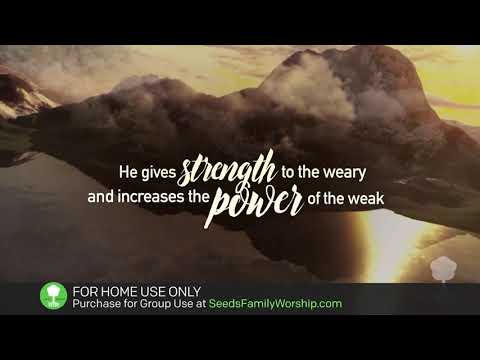
Sing it. Three verses arrive whole and in order. Check the words against an NIV rather than the ESV the album page names, and read verse 28 once, so the singer knows why the strength renews.
~ FAITHFUL
“Soar Like Eagles”
Seeds Family Worship (now Seeds Kids Worship)
Sing it. Three verses arrive whole and in order. Check the words against an NIV rather than the ESV the album page names, and read verse 28 once, so the singer knows why the strength renews.✓ Three consecutive verses sung whole and in order, with a chorus built entirely from the passage's own clauses
⚠ The album page lists the scripture version as ESV while the song's own chart credits the NIV, and the sung wording is the NIV's. The label a listener sees first names the wrong text
 ~ FAITHFUL
“Holy, Holy, Holy”
Audrey Assad
Sing it. The threefold cry is the verse, kept exactly. The Trinity line is the church's reading of that cry, stated openly. Knowing which layer is Isaiah and which is doctrine is the whole assignment here.
~ FAITHFUL
“Holy, Holy, Holy”
Audrey Assad
Sing it. The threefold cry is the verse, kept exactly. The Trinity line is the church's reading of that cry, stated openly. Knowing which layer is Isaiah and which is doctrine is the whole assignment here.✓ The seraphim's threefold cry is carried exactly, and every name the hymn gives God is one scripture gives Him
⚠ In the Hebrew, the threefold repetition is emphasis, the superlative at full strength. Naming the three persons in it is the church's later reading, not the verse's own statement
More songs like this
 NOT A QUOTE
“You Say”
Lauren Daigle
Yes, you can sing it. It is testimony, not a quotation. The things it reports God saying can be matched to scripture. The song names none of them, so read one alongside it.
NOT A QUOTE
“You Say”
Lauren Daigle
Yes, you can sing it. It is testimony, not a quotation. The things it reports God saying can be matched to scripture. The song names none of them, so read one alongside it.✓ The song's move is one this passage makes. God tells a hearer who he is in verse 9, and takes his right hand and says not to fear in verse 13
⚠ The “You” is identified just once. A published review says that single reference sets the whole song's context, and nothing else in the words points to God overtly or subtly
 NOT A QUOTE
“Ever Be”
Bethel Music, Kalley Heiligenthal
Sing it. It names no verse, and what it says about God holds. Just notice that Isaiah 62 ends with God rejoicing over his people, and the only joy this song sings runs the other way.
NOT A QUOTE
“Ever Be”
Bethel Music, Kalley Heiligenthal
Sing it. It names no verse, and what it says about God holds. Just notice that Isaiah 62 ends with God rejoicing over his people, and the only joy this song sings runs the other way.✓ Its images come from one continuous stretch of scripture, Isaiah 61:3 through 62:5, rather than from verses scattered across the Bible: beauty for ashes and a garment in 61:3, the clothing in 61:10, the retired names in 62:4, the bride in 62:5
⚠ Isaiah 62:5 says God rejoices over his people. The song's only sung rejoicing is the singer's, aimed at God. Nothing in it is false, and the passage's own climax is absent
 NOT A QUOTE
“Man of Sorrows”
Reawaken Hymns
Sing it. Nothing here is quoting. The hymn takes three King James words spoken in contempt and sings them as a title of honor, and that reversal is the one Isaiah's chapter itself makes.
NOT A QUOTE
“Man of Sorrows”
Reawaken Hymns
Sing it. Nothing here is quoting. The hymn takes three King James words spoken in contempt and sings them as a title of honor, and that reversal is the one Isaiah's chapter itself makes.✓ The opening phrase is Isaiah 53:3 in the King James wording, and the hymn treats it as shocking, which is what the verse's own context makes it
⚠ In the verse the phrase is a report, not a name. The first stanza's marvel depends on knowing that, and heard cold, "man of sorrows" can register as one more honorific instead of an insult the text records