Isaiah 41:8-13 vs. “You Say”
Lauren Daigle · checked 2026-09-06
What we checked
Graded against the standard
Quotation criteria not graded: this song never presents its words as scripture
Applies to every song the Name held holy · God shown holy · true of God · the standard
✓ What's good
- The song's move is one this passage makes. God tells a hearer who he is in verse 9, and takes his right hand and says not to fear in verse 13
- Nothing is presented as scripture. The words cite no verse and name no translation, so there is no misquotation here to find
- The claims are traceable, even though the song does not trace them. Its catalogue entry lists Isaiah 41:13 and Hebrews 11:6, and a published study pairs four claims with four passages
- Daigle's own account of the writing, published by CCM Magazine, names no passage and claims none. She describes the day after her first Dove Awards and a season of asking where she fit
⚠ Cautions
- The “You” is identified just once. A published review says that single reference sets the whole song's context, and nothing else in the words points to God overtly or subtly
- Isaiah names its hearer in the first line: Israel, God's servant, Jacob whom He chose. The song's hearer is whoever is singing, and no name is attached
- In Isaiah the reason not to fear is about God: “for I am with you,” “for I am your God,” “For I am the LORD your God.” The song's repeated line is about the singer
- The song reports God speaking and points to no place where He said it. That is not a misquote. It does leave the singer with nothing to look up
- It crossed to mainstream radio in January 2019 and reached No. 1 on Adult Contemporary, so most of the people who heard it were not in church. The Berean Test review says a listener who misses the one word could hear a boyfriend-or-girlfriend song
Verse Proof
Isaiah 41:8-13The text in BSB (Berean Standard Bible)
“But you, O Israel, My servant, Jacob, whom I have chosen, descendant of Abraham My friend— I brought you from the ends of the earth and called you from its farthest corners. I said, ‘You are My servant.’ I have chosen and not rejected you. Do not fear, for I am with you; do not be afraid, for I am your God. I will strengthen you; I will surely help you; I will uphold you with My righteous right hand. Behold, all who rage against you will be ashamed and disgraced; those who contend with you will be reduced to nothing and will perish. You will seek them but will not find them. Those who wage war against you will come to nothing. For I am the LORD your God, who takes hold of your right hand and tells you: Do not fear, I will help you.”
Isaiah 41 sits in the comfort section of the book, chapters 40 onward, spoken to a people facing exile. God is the speaker in these verses. He names the hearer in the first line: Israel His servant, Jacob whom He chose, the descendant of Abraham. Verses 8 and 9 look back at what He has already done. He brought them from the ends of the earth. He called them. He chose them and did not reject them. Verse 10 is a fear-not oracle with three promises in a row: strengthen, help, uphold. Verses 11 and 12 say their opponents will come to nothing. Verse 13 repeats the fear-not and adds a picture. God takes hold of the hearer's right hand, and He speaks.
What the song says, described not quoted
One voice sings the whole song, and it speaks to a “You” that the words identify just once. A published review summarizes the content in three parts: a struggle between Satan's lies and the comforting voice of God, a declaration of the singer's worth to God, and surrender to God's ways. A study episode on the song takes its identity claims one at a time and gives each a passage. God's love in Ephesians 2:4-5. Christ's strength in 2 Corinthians 12:7-10. Being held in Isaiah 41:9-10. Belonging to God in Isaiah 43:1-7. The closing section is a repeated statement of agreement.
Nothing in the song is offered as a quotation. No verse is cited in the words, and no translation is named. The same review counts “one explicit reference to God that sets the context for the entire song”, and says nothing else in the words points to God “in either an overt or subtle manner”.
Daigle's own account of the writing, published by CCM Magazine, names no passage. She describes the day after her first Dove Awards, walking into the studio with her producers, and feeling “completely overwhelmed.” She says the season raised “the issue of identity and trying to figure out how to exist when I felt like so many things were pulling me in so many different directions,” and that people build complexes “based on insecurity, based on fear, based on rejection.”
The song and the passage make the same move. In verse 9 God tells a hearer who he is: “I said, ‘You are My servant.’” The song reports God telling the singer who she is. Three things sit in the passage and not in the song. Isaiah names the hearer. Isaiah prints the words, so a reader can see what was said. And Isaiah gives the reason. The fear-not in verse 10 rests on two clauses about God, “for I am with you” and “for I am your God,” and verse 13 opens with a third, “For I am the LORD your God.” The song's repeated statement is about the singer.
▸ Official upload. Now listen with the proof in mind.
In Isaiah 41 God does say who the hearer is. He also says who He is, and that is the reason.
Why it matters
When a lyric says that God says something, the claim arrives with His authority attached. That is not a fault by itself. Scripture is full of God speaking, and scripture prints the words. A song that reports the speech without a place to look it up leaves the singer holding a claim the song gives no way to check. You have to already know the passage, or take the song's word for it.
Is it safe to dwell on?
Sung on repeat, this song moves between God and the singer.
What loops here is a sentence about yourself, sourced to God. Sung enough times, that sentence settles in as something you know. When it is true, that is a good thing to plant, and for someone in the season Daigle describes writing it in, it may be the thing that gets them through the week.
The dwelling tag is mixed because nearly every line holds two parties. God is the one the chorus reports speaking, and the singer is what He is reported to be speaking about. The verses stay with the singer's own situation, which is what Daigle says the song came out of.
The thing worth noticing about repetition is that the sentence has no address on it. Sung a hundred times, it is still not attached to a page. Isaiah 41 attaches it. Six verses give you the same comfort with the hearer named, the words printed, and the reason stated as God's own I-am. Reading verses 8 to 13 next to the song costs a minute and puts all three back.
Helpful comparison
One page outside the song does point somewhere. Worship Together, the song-resource platform Capitol CMG Publishing runs, carries it under CCLI number 7071357 and lists two scripture references, Isaiah 41:13 and Hebrews 11:6. Capitol CMG Publishing administers a share of this song, so that is a publisher-side page rather than a neutral index. Both are checkable. Isaiah 41:13 is God taking hold of a hand and saying not to fear. Hebrews 11:6 says anyone who approaches God must believe He exists and rewards those who seek Him. Nothing on the page says who supplied that list, and nothing in the song points a listener to either verse. Neither citation names the span checked here. Isaiah 41:8-13 is this page's own, the shortest run holding the verse the platform cites, the verses the study cites, and the hearer named in verse 8.
Third parties reach much further. The study episode above gives each of the four identity claims a passage. A published review of the song cites more than sixty distinct references across the lyric, counted on the page, including Ephesians 2:4-5, Galatians 2:20 and 2 Corinthians 12:9-10. The claims can be matched to a great deal of scripture. The song matches them to none.
The site's other Isaiah 41 proof asks the opposite half of the question. “How Firm a Foundation,” recorded by Sovereign Grace Music, sings verse 10's promises in God's own first-person voice, in the King James diction its 1787 congregation would have known. That entry checks a song that speaks as God. This one checks a song that reports Him.
Sources
- Lauren Daigle — You Say, official music video · (the recording checked for this proof; oEmbed returns author_name “Lauren Daigle” and title “Lauren Daigle - You Say (Official Music Video)”, channel @laurendaiglemusic)
- Worship Together — You Say · (the page's own fields: Writer(s) Michael Donehey, Lauren Daigle, Jason Ingram, Bebo Norman, Paul Mabury; CCLI #: 7071357; Scripture Reference: Isaiah 41:13; Hebrews 11:6; themes God's Attributes, Peace & Hope, Testimony. No translation named)
- PraiseCharts — You Say, sheet music · (same CCLI number, the same five authors with Mike Donehey spelled short, the copyright line © 2016 CentricSongs, See You At The Pub, AppStreet Music admin Capitol CMG Publishing, with Fellow Ships Music, Flychild Publishing, So Essential Tunes and Formerly Music admin Essential Music Publishing, and a theme list that includes Identity)
- Wikipedia — You Say · (released 13 July 2018 as the lead single from Look Up Child on Centricity, Warner Bros. and 12Tone; No. 29 on the Billboard Hot 100; 132 weeks at No. 1 on Hot Christian Songs; released to mainstream radio 15 January 2019 and No. 1 on Adult Contemporary; six-times platinum; 2019 Grammy for Best Contemporary Christian Music Performance/Song and the Dove Award for Song of the Year. Note its infobox credits three writers where both catalogues above list five)
- Wikipedia — Look Up Child · (the album, released 7 September 2018 on Centricity Music)
- CCM Magazine — Lauren Daigle, Story Behind the Song “You Say” · (Daigle's own account of the writing: the day after her first Dove Awards, “completely overwhelmed”, the questions “Where do I fit in, where is my security, where is my footing?”, “the issue of identity and trying to figure out how to exist when I felt like so many things were pulling me in so many different directions”, and complexes “based on insecurity, based on fear, based on rejection”. She names no passage)
- More Than A Song, episode 232 — “You Say” by Lauren Daigle · (29 July 2018; a third-party study episode, not the rights holder, that pairs the song's four identity claims with Ephesians 2:4-5, 2 Corinthians 12:7-10, Isaiah 41:9-10 and Isaiah 43:1-7, and states that “Everything God says of US is directly related to HIM”)
- The Berean Test — Lauren Daigle, You Say · (2 January 2019. Used here for four things: its summary of the song's content as a struggle between Satan's lies and the comforting voice of God, a declaration of worth to God, and surrender to God's ways; “one explicit reference to God that sets the context for the entire song”; that nothing else in the words points to God “in either an overt or subtle manner”, so a listener who misses that one word could take it for a boyfriend or girlfriend song; and its citation count. The page carries 65 distinct scripture references by a count of every book chapter:verse string on it, which is the basis for “more than sixty” above. Its score is not used here)
- Faithful Stewardship — DiM, “You Say” by Lauren Daigle · (2 October 2018; 2 October 2018; treats the chorus's “You” as only supposedly God's voice. Its verdict and its reading of motive are not used here)
- BibleHub — Isaiah 41, Berean Standard Bible · (the chapter, for the named hearer in verses 8 and 9, the fear-not clauses in verse 10, and the hand and the speech in verse 13)
Corrections
No corrections to this proof yet.
Think we got something wrong? Tell us what and where, and we will check it against the text. Real errors get fixed here, dated, in public. Every correction on the site →
Where the text survives the song
 ~ FAITHFUL
“How Firm a Foundation”
Sovereign Grace Music
Sing it. When this hymn speaks as God, it repeats what he has said: the fear-not stanza is Isaiah 41:10 in close King James wording, and the first stanza announces that plan out loud.
~ FAITHFUL
“How Firm a Foundation”
Sovereign Grace Music
Sing it. When this hymn speaks as God, it repeats what he has said: the fear-not stanza is Isaiah 41:10 in close King James wording, and the first stanza announces that plan out loud.✓ The first stanza announces the method: everything sung in God's voice afterward is presented as what he has already said in his word
⚠ No translation is named, so the King James wording has to be recognised rather than checked. In 1787 that went without saying; in 2026 it does not
 ~ FAITHFUL
“Soar Like Eagles”
Seeds Family Worship (now Seeds Kids Worship)
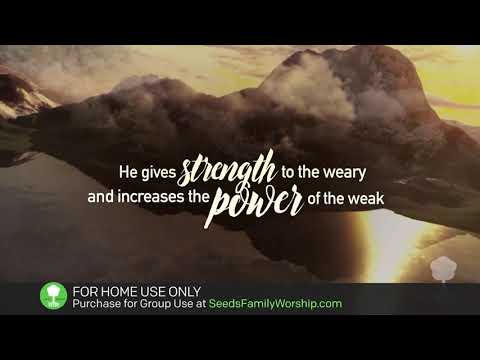
Sing it. Three verses arrive whole and in order. Check the words against an NIV rather than the ESV the album page names, and read verse 28 once, so the singer knows why the strength renews.
~ FAITHFUL
“Soar Like Eagles”
Seeds Family Worship (now Seeds Kids Worship)
Sing it. Three verses arrive whole and in order. Check the words against an NIV rather than the ESV the album page names, and read verse 28 once, so the singer knows why the strength renews.✓ Three consecutive verses sung whole and in order, with a chorus built entirely from the passage's own clauses
⚠ The album page lists the scripture version as ESV while the song's own chart credits the NIV, and the sung wording is the NIV's. The label a listener sees first names the wrong text
 ~ FAITHFUL
“Holy, Holy, Holy”
Audrey Assad
Sing it. The threefold cry is the verse, kept exactly. The Trinity line is the church's reading of that cry, stated openly. Knowing which layer is Isaiah and which is doctrine is the whole assignment here.
~ FAITHFUL
“Holy, Holy, Holy”
Audrey Assad
Sing it. The threefold cry is the verse, kept exactly. The Trinity line is the church's reading of that cry, stated openly. Knowing which layer is Isaiah and which is doctrine is the whole assignment here.✓ The seraphim's threefold cry is carried exactly, and every name the hymn gives God is one scripture gives Him
⚠ In the Hebrew, the threefold repetition is emphasis, the superlative at full strength. Naming the three persons in it is the church's later reading, not the verse's own statement
More songs like this
 NOT A QUOTE
“Rescue”
Lauren Daigle
Sing it as comfort, not as a quotation. What it promises, Psalm 34 says God does. The psalm says it about Him. The song says it as Him, and never names its speaker.
NOT A QUOTE
“Rescue”
Lauren Daigle
Sing it as comfort, not as a quotation. What it promises, Psalm 34 says God does. The psalm says it about Him. The song says it as Him, and never names its speaker.✓ Every promise the song voices has a counterpart in this passage. Psalm 34:17-18 says the LORD hears the cry, delivers from all troubles, stays near the brokenhearted and saves the contrite in spirit
⚠ The song is sung in God's first person throughout, and Psalm 34:17-18 speaks about the LORD in the third person. The one first-person voice in the chapter is David's at verse 11, teaching the fear of the LORD
 NOT A QUOTE
“Your Way's Better”
Forrest Frank
Sing it. It is a prayer in the singer's own words, not a quotation, so there is nothing here to misquote. The song names no passage. This site pairs it with Isaiah 55:6-9, where God states the comparison.
NOT A QUOTE
“Your Way's Better”
Forrest Frank
Sing it. It is a prayer in the singer's own words, not a quotation, so there is nothing here to misquote. The song names no passage. This site pairs it with Isaiah 55:6-9, where God states the comparison.✓ Presents nothing as scripture. No verse reference, no translation named, no quotation framing, so nothing in it can be a misquote
⚠ The song names no passage. The verse you hear under it was chosen by whoever paired them. A study cited below picks four, and this entry picks a fifth
 NOT A QUOTE
“Ever Be”
Bethel Music, Kalley Heiligenthal
Sing it. It names no verse, and what it says about God holds. Just notice that Isaiah 62 ends with God rejoicing over his people, and the only joy this song sings runs the other way.
NOT A QUOTE
“Ever Be”
Bethel Music, Kalley Heiligenthal
Sing it. It names no verse, and what it says about God holds. Just notice that Isaiah 62 ends with God rejoicing over his people, and the only joy this song sings runs the other way.✓ Its images come from one continuous stretch of scripture, Isaiah 61:3 through 62:5, rather than from verses scattered across the Bible: beauty for ashes and a garment in 61:3, the clothing in 61:10, the retired names in 62:4, the bride in 62:5
⚠ Isaiah 62:5 says God rejoices over his people. The song's only sung rejoicing is the singer's, aimed at God. Nothing in it is false, and the passage's own climax is absent