Isaiah 6:1-3 vs. “Holy, Holy, Holy”
Audrey Assad · checked 2026-08-02
What we checked
Graded against the standard
Quotation criteria this song presents words as scripture, so these apply
Applies to every song the Name held holy · God shown holy · true of God · the standard
✓ What's good
- The seraphim's threefold cry is carried exactly, and every name the hymn gives God is one scripture gives Him
- Addressed to God from the first line to the last; the singer appears once, in the plural, as part of a song rising
- The stanza about glory hidden from sinful eyes matches the scene's own reticence: even the sinless seraphim cover their faces (Isaiah 6:2)
- The doctrine it adds is worn openly. A hymn written for Trinity Sunday and sung to a tune named Nicaea is not concealing its reading
⚠ Cautions
- In the Hebrew, the threefold repetition is emphasis, the superlative at full strength. Naming the three persons in it is the church's later reading, not the verse's own statement
- The title sung with the cry, Lord God Almighty, belongs to Revelation 4:8; Isaiah's seraphim say the LORD of Hosts. Heber folds the two throne scenes into one, and the crowns in his full text come from Revelation 4:10 as well
- Isaiah's cry has a second half, the whole earth full of His glory, and the hymn does not carry it. Glory filling the earth and glory hidden from sinful eyes can both be true, but only the first is in the verse
- No reference or translation is named anywhere, and beyond the threefold cry the hymn's wording matches no translation. For many singers this hymn is the only copy of the cry they carry
Verse Proof
Isaiah 6:1-3The text in BSB (Berean Standard Bible)
“In the year that King Uzziah died, I saw the Lord seated on a throne, high and exalted; and the train of His robe filled the temple. Above Him stood seraphim, each having six wings: With two wings they covered their faces, with two they covered their feet, and with two they were flying. And they were calling out to one another: “Holy, holy, holy is the LORD of Hosts; all the earth is full of His glory.”
Isaiah's own report of a vision, dated to the year King Uzziah died, around 740 BC. He sees the Lord enthroned in the temple, the train of the robe filling the whole house, and above the throne seraphim who use four of their six wings to cover their own faces and feet. The threefold cry is what they call out to one another. It is heaven's liturgy overheard, not a congregation's song, and its second half is a claim about the earth: the whole of it is full of His glory. In the verses that follow, the doorposts shake, the house fills with smoke, and Isaiah's response to what he has seen is to pronounce himself ruined, a man of unclean lips, before a coal from the altar and a commission send him out.
What the song says, described not quoted
This is Reginald Heber's 1826 hymn, and Assad's recording sings three of his four stanzas, with the opening stanza returning at the end as a bookend. Every stanza opens with the seraphim's threefold holy, addressed to the Lord God Almighty. The first sets the scene at morning worship, the singers' song rising early to God, who is named merciful and mighty, and it closes by naming God as Trinity, three persons in one God. The next stanza sung here says God's glory is hidden by darkness from sinful human eyes, that God alone is holy, none beside Him, perfect in power, in love, and in purity. The last has everything God has made praising His name across earth, sky, and sea, and ends on the Trinity again. Heber's remaining stanza, not sung in this recording, is a throne-room scene: the saints laying golden crowns down around a sea like glass, cherubim and seraphim bowing, and God described as past, present, and everlasting. Nothing anywhere in the hymn is framed as a quotation, and no reference or translation is given.
The cry itself is carried intact: holy, three times, exactly as the seraphim say it. Around the cry, three things shift. The title sung with it, Lord God Almighty, is the title from the other place this cry appears, Revelation 4:8; Isaiah's seraphim say the LORD of Hosts. The cry's second half, the whole earth full of His glory, is not carried; the hymn's third stanza instead dwells on glory hidden from sinful eyes. And the hymn adds a reading: it takes the three-ness of the cry and names the three persons of the Trinity, once at the close of the first stanza and again at the close of the last. That reading is not smuggled in. Heber wrote the hymn for Trinity Sunday, to sit beside the creed in the service, and the tune it has been sung to since 1861 is named Nicaea, after the council that defined the doctrine. The interpretation is the hymn's stated purpose. It is still an interpretation: in the Hebrew, repetition is emphasis, the strongest the language gives, and Isaiah 6 names no persons.
▸ Official upload. Now listen with the proof in mind.
The seraphim supply the holy, holy, holy. Nicaea supplies the three persons. Sing it knowing which is which.
Why it matters
The threefold holy has exactly two addresses in scripture, this verse and Revelation 4:8, and Heber's hymn has been the main road by which English-speaking congregations sing it for two centuries. What the hymn adds is not decoration but doctrine. It was written for Trinity Sunday, it folds the three-ness of the cry into the three persons, and its tune is named after the council of Nicaea. None of that is hidden; it is the hymn's design. But a singer who learns the verse from the hymn learns the interpretation fused to it, and it is worth being able to say which words the seraphim actually cry.
Is it safe to dwell on?
Sung on repeat, this song fixes your attention on God.
What looping this plants is a description of God with a creed attached: holy three times over, mighty, merciful, alone in holiness, praised by everything He made, and, each time the bookend stanza closes, three persons in one God. There is almost no first person in it; the singer appears once, in the plural, and everything else is about God. That grammar forms you toward God, and it is one reason this hymn has survived two centuries of morning services. The one thing worth adding by hand is the scene. Read Isaiah 6:1-7 once, and the repetition carries a throne, a filled temple, creatures who cover their faces, and a man who thought he was finished, not only a melody. And notice, without alarm, that doctrine learned by melody is still doctrine. Singing this hymn is how generations have memorized the Trinity, which is exactly what it was written to do.
Helpful comparison
The threefold cry has two addresses, and this site has now checked songs at both. "Revelation Song" and "Holy Forever" sit at Revelation 4:8, where living creatures cry it day and night and where Lord God Almighty is the title in the verse, though only the first of those two songs actually sings the verse's words. Heber draws his title from there, while the cry's older address is this one, Isaiah 6:3, roughly eight centuries earlier. One detail from Heber's full text belongs in that comparison even though Assad's recording omits the stanza carrying it: Revelation's cry ends with a clause about God's arriving, who was and is and is to come, and Heber recast it as plain endless duration, past, present, evermore. The Revelation Song proof notes that keeping the arrival is a mark of precision. Heber, two centuries earlier, is where the smoothing shows up. It is the one place the hymn trades a statement of the text for a rounder one.
The repetition is the way Hebrew makes a superlative, as the holiest place is the holy of holies. Whether the trinitarian reading of it is true is a doctrine question outside this proof's job. That it is a reading, and not the verse's own statement, is checkable.
Sources
- Audrey Assad — Holy, Holy, Holy (official upload) · (the recording checked for this proof, Audrey Assad's own channel)
- Wikipedia — Inheritance (Audrey Assad album) · (hymns album, Fortunate Fall Records, released February 12, 2016; the track credited to Heber and Dykes)
- NewReleaseToday — Holy, Holy, Holy lyrics · (the stanzas Assad's recording includes; the crowns stanza is absent)
- Wikipedia — Holy, Holy, Holy! Lord God Almighty · (Heber, written for Trinity Sunday to accompany the creed; published posthumously 1826; basis in Revelation 4:8-11 and Isaiah 6:3; Dykes's tune Nicaea, 1861)
- Hymnary.org — Holy, Holy, Holy! Lord God Almighty! · (written 1823, first published in the 1826 third edition of the Banbury Selection; scripture references Isaiah 6:1-10 and Revelation 4:8-11; Nicaea named for the council)
- Hymnology Archive — Holy, holy, holy! Lord God Almighty · (the hymn's history and Revelation 4 basis; Dykes wrote Nicaea for Hymns Ancient and Modern, 1861)
- BibleHub — Isaiah 6:3 study · (the threefold repetition as a Hebrew device of emphasis, marking the superlative of God's holiness)
Corrections
- The comparison paragraph in analysis credited the Holy Forever proof with noting that keeping the verse's arrival clause is a mark of precision. Holy Forever does not sing that clause, and its proof was corrected the same day. The observation belongs to the Revelation Song proof, which is what the paragraph now says.
Think we got something wrong? Tell us what and where, and we will check it against the text. Real errors get fixed here, dated, in public. Every correction on the site →
Where the text survives the song
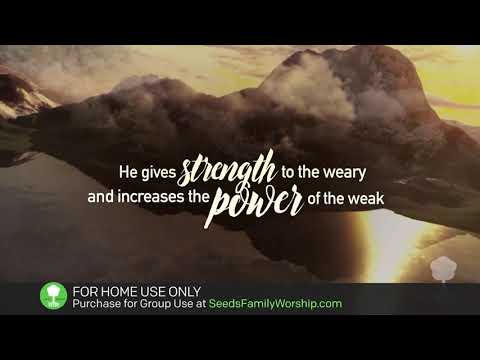 ~ FAITHFUL
“Soar Like Eagles”
Seeds Family Worship (now Seeds Kids Worship)
Sing it. Three verses arrive whole and in order. Check the words against an NIV rather than the ESV the album page names, and read verse 28 once, so the singer knows why the strength renews.
~ FAITHFUL
“Soar Like Eagles”
Seeds Family Worship (now Seeds Kids Worship)
Sing it. Three verses arrive whole and in order. Check the words against an NIV rather than the ESV the album page names, and read verse 28 once, so the singer knows why the strength renews.✓ Three consecutive verses sung whole and in order, with a chorus built entirely from the passage's own clauses
⚠ The album page lists the scripture version as ESV while the song's own chart credits the NIV, and the sung wording is the NIV's. The label a listener sees first names the wrong text
 ~ FAITHFUL
“How Firm a Foundation”
Sovereign Grace Music
Sing it. When this hymn speaks as God, it repeats what he has said: the fear-not stanza is Isaiah 41:10 in close King James wording, and the first stanza announces that plan out loud.
~ FAITHFUL
“How Firm a Foundation”
Sovereign Grace Music
Sing it. When this hymn speaks as God, it repeats what he has said: the fear-not stanza is Isaiah 41:10 in close King James wording, and the first stanza announces that plan out loud.✓ The first stanza announces the method: everything sung in God's voice afterward is presented as what he has already said in his word
⚠ No translation is named, so the King James wording has to be recognised rather than checked. In 1787 that went without saying; in 2026 it does not
 ✓ VERIFIED
“Mark 10”
Streetlights
Play it freely. This is Mark 10 itself, read word for word in a named translation. The line about all things being possible arrives as the answer to a question about being saved.
✓ VERIFIED
“Mark 10”
Streetlights
Play it freely. This is Mark 10 itself, read word for word in a named translation. The line about all things being possible arrives as the answer to a question about being saved.✓ The whole chapter, in order, so verse 27 arrives after the rich man’s scene and after the disciples ask who can be saved, instead of standing on its own
⚠ “Word-for-word” here describes the reading, not the translation theory. Streetlights uses it for what is read. Tyndale uses the same phrase for a different thing
More songs like this
~ FAITHFUL
“Soar Like Eagles”
Seeds Family Worship (now Seeds Kids Worship)
Sing it. Three verses arrive whole and in order. Check the words against an NIV rather than the ESV the album page names, and read verse 28 once, so the singer knows why the strength renews.✓ Three consecutive verses sung whole and in order, with a chorus built entirely from the passage's own clauses
⚠ The album page lists the scripture version as ESV while the song's own chart credits the NIV, and the sung wording is the NIV's. The label a listener sees first names the wrong text
 ✎ DEPARTS
“Wait on You”
Elevation Worship & Maverick City Music
Sing it. The vow to wait is one Isaiah 40 would recognize. Sing the closing refrain as an echo of the verse, not as the verse itself: the wording drifts where the sound does not.
✎ DEPARTS
“Wait on You”
Elevation Worship & Maverick City Music
Sing it. The vow to wait is one Isaiah 40 would recognize. Sing the closing refrain as an echo of the verse, not as the verse itself: the wording drifts where the sound does not.✓ The closing refrain plants the whole promise of Isaiah 40:31, waiting, renewed strength, wings, running and walking that do not give out, in the verse's own third person
⚠ The refrain sounds like the King James and is not quite it. Transcriptions of the recording show a soaring clause the verse does not have and the walking sung before the running. Check a KJV before quoting the refrain as the verse
 NOT A QUOTE
“It Is Well With My Soul”
Audrey Assad
Sing it. The hymn quotes nothing and never says it is scripture, and what it says about the cross holds up. Just do not carry the refrain as a line from 2 Kings.
NOT A QUOTE
“It Is Well With My Soul”
Audrey Assad
Sing it. The hymn quotes nothing and never says it is scripture, and what it says about the cross holds up. Just do not carry the refrain as a line from 2 Kings.✓ Never says it is quoting, anywhere: no verse reference, no translation named, nothing framed as scripture
⚠ The refrain's phrase matches 2 Kings 4:26 in the King James and World English wording and is widely repeated as coming from there, but no documented account of the hymn's origin connects them