2 Kings 4:23-26 vs. “It Is Well With My Soul”
Audrey Assad · checked 2026-08-01
What we checked
Graded against the standard
Quotation criteria not graded: this song never presents its words as scripture
Applies to every song the Name held holy · God shown holy · true of God · the standard
✓ What's good
- Never says it is quoting, anywhere: no verse reference, no translation named, nothing framed as scripture
- Its third stanza's content, sin nailed to the cross and no longer carried, tracks Colossians 2:14, which is the reference hymnal indexes assign to it most consistently
- The history behind it is genuinely documented, including contemporary newspaper accounts of the collision and the surviving telegram
- The recording checked here sings Spafford's stanzas as written and adds no modern bridge or chorus, so what is sung is the historic text
⚠ Cautions
- The refrain's phrase matches 2 Kings 4:26 in the King James and World English wording and is widely repeated as coming from there, but no documented account of the hymn's origin connects them
- In the passage that answer is given twice by a woman who has told nobody her son is dead, and one verse later the prophet says her soul is in deep distress. It is not a statement of settled peace
- The best-known version of the backstory, that Spafford wrote the words as his ship passed the wreck site, is one of three surviving first-hand accounts, and the other two place it elsewhere
- The Berean Standard Bible renders the Shunammite's answer "Everything is all right," so the resemblance depends entirely on which translation a listener grew up with
Verse Proof
2 Kings 4:23-26The text in BSB (Berean Standard Bible)
“Why would you go to him today?” he replied. “It is not a New Moon or a Sabbath.” “Everything is all right,” she said. Then she saddled the donkey and told her servant, “Drive onward; do not slow the pace for me unless I tell you.” So she set out and went to the man of God at Mount Carmel. When the man of God saw her at a distance, he said to his servant Gehazi, “Look, there is the Shunammite woman. Please run out now to meet her and ask, ‘Are you all right? Is your husband all right? Is your child all right?’” And she answered, “Everything is all right.”
Elisha had promised a son to a wealthy woman of Shunem who kept a room for him, and the boy was born. Years later the child complained of his head out in the harvest field, was carried in to his mother, sat on her lap until noon, and died. She laid him on the prophet's bed, shut the door, and asked her husband for a servant and a donkey. Verses 23 to 26 are what she says on the way. Her husband asks why she would go to the prophet on a day that is neither New Moon nor Sabbath, and she answers that everything is all right. She tells the servant to keep the pace up. When Elisha sees her coming and sends Gehazi to ask after her husband and her child, she gives the same answer a second time. She has told nobody the boy is dead. One verse later she reaches Elisha, takes hold of his feet, and the prophet says her soul is in deep distress.
What the song says, described not quoted
The hymn is a first-person confession of trust. The words are Horatio Spafford's, a Chicago lawyer whose four daughters drowned when the Ville du Havre sank in 1873, and the tune is Philip Bliss's, named after the ship. The first stanza sets peace and sorrow side by side and says the singer's soul is well under either one. The second names trouble and rests on the assurance that Christ has taken care of the singer's helpless condition. The third is about sin nailed to the cross and no longer carried. A refrain repeating the title phrase follows each stanza. Audrey Assad's recording sings three of Spafford's stanzas in order with the refrain after each and adds no modern material. No verse is cited anywhere in the hymn and no translation is named.
The link between this hymn and 2 Kings 4 is a wording resemblance and nothing more. The King James and the World English Bible both render the Shunammite's answer as "It is well," which is the hymn's title phrase and the first line of its refrain. That resemblance gets repeated as fact. The Vineyard Churches UK article on the hymn states flatly that Spafford's words come from 2 Kings 4:26 and echo the Shunammite woman, and gives no source for it. No documented account of the hymn's origin names the verse, and the reference works that index the text line by line assign other passages entirely. Even granting the borrowing, the two phrases do different jobs. Hers is what a mother says twice to people who cannot raise her son, on her way to the one she believes can. The hymn's is a settled confession made to God about the singer's own soul.
▸ Official upload. Now listen with the proof in mind.
What makes this refrain feel like scripture is a story, not a citation.
Why it matters
Almost nobody meets this hymn without the story attached. The shipwreck itself is well documented, down to the collision, the twelve minutes, and a telegram from Anna Spafford preserved at the Library of Congress. The part that gets told hardest is the part that is not settled: three first-hand accounts of when Spafford wrote the words survive, they contradict each other, and the manuscript is undated. That matters here because the hymn does not say it is scripture at all, so whatever weight it carries in a room is coming from its history rather than from a reference, and a history deserves the same checking a verse gets.
Is it safe to dwell on?
Sung on repeat, this song moves between God and the singer.
The dwelling tag is mixed because the words are mostly about the singer's own soul while the ground they stand on sits outside the singer. That is the hymn's shape: a statement about my condition, resting on the cross rather than on how the day is going. Sung on repeat it plants a sentence a person can say when the feeling behind it has gone, which is why it is reached for at funerals and in hospital rooms. Worth noticing is what it does not plant. It leaves no verse to look up and no reference to carry away, so what stays is the confession and the story behind it. If you want the confession anchored to a text, read Colossians 2:14 next to the third stanza, which is where the hymnals have long pointed.
Helpful comparison
Three things are checkable, and they point the same direction.
First, the wording. The King James and the World English Bible both render the Shunammite's answer "It is well." The Berean Standard Bible renders it "Everything is all right." The resemblance a reader hears belongs to one family of English translations, not to the verse itself. The translation toggle on this page will make the phrase appear and disappear.
Second, the indexes. Hymnary collects the scripture references that individual hymnals assign to this text. The ones that recur are Philippians 4:7, Colossians 2:14, Isaiah 34:4, 1 Corinthians 15:52, Isaiah 66:12 and 3 John 1:2. Across more than twenty hymnal listings, 2 Kings 4:26 shows up in one. The Hymnology Archive's line-by-line notes name Isaiah 66:12, 2 Corinthians 12:7, Colossians 2:14, 1 Thessalonians 4:16 and Revelation, and do not name 2 Kings anywhere.
Third, the passage. If the borrowing were real it still would not mean what it is usually taken to mean. Verse 27 has Elisha saying her soul is in deep distress, and verse 28 has her putting a bitter question to him. The answer she gave twice on the road was not a report on the state of her soul. It was a woman refusing to be slowed down.
Sources
- Audrey Assad — It Is Well With My Soul · (the recording checked for this proof; uploaded to Audrey Assad's own channel, oEmbed author_name "Audrey Assad")
- Wikipedia — Inheritance (Audrey Assad album) · (hymns album, released 12 February 2016, Fortunate Fall Records; the track credited to Spafford and Bliss)
- NewReleaseToday — lyric listing for the recording · (three Spafford stanzas with the refrain after each, no added modern material)
- Hymnology Archive — It is well with my soul · (the three conflicting accounts of when it was written, the undated Library of Congress manuscript, the telegram, first publication in Gospel Hymns No. 2, and the line-by-line allusions, which do not include 2 Kings)
- Hymnary.org — When Peace, Like a River · (author, composer, tune VILLE DU HAVRE, 1876 publication, and the per-stanza and per-hymnal scripture indexes)
- Vineyard Churches UK — It is Well with My Soul · (an example of the 2 Kings 4:26 claim asserted without a source)
- Discipleship Ministries — History of Hymns: "It Is Well with My Soul" · (the wreck-site account given as "said to have been penned," with no verse allusions identified in the text)
- Wikipedia — Horatio Spafford · (the 1871 fire and his real-estate losses, the four daughters' names and ages, the "Saved alone" telegram, and his death in 1888)
Corrections
No corrections to this proof yet.
Think we got something wrong? Tell us what and where, and we will check it against the text. Real errors get fixed here, dated, in public. Every correction on the site →
Where the text survives the song
 ✓ VERIFIED
“Mark 10”
Streetlights
Play it freely. This is Mark 10 itself, read word for word in a named translation. The line about all things being possible arrives as the answer to a question about being saved.
✓ VERIFIED
“Mark 10”
Streetlights
Play it freely. This is Mark 10 itself, read word for word in a named translation. The line about all things being possible arrives as the answer to a question about being saved.✓ The whole chapter, in order, so verse 27 arrives after the rich man’s scene and after the disciples ask who can be saved, instead of standing on its own
⚠ “Word-for-word” here describes the reading, not the translation theory. Streetlights uses it for what is read. Tyndale uses the same phrase for a different thing
 ✓ VERIFIED
“Proverbs 4”
Streetlights
Play it freely. This is Proverbs 4 itself, read word for word in a named translation. “Guard your heart” arrives with the commands about the mouth, the eyes and the feet still attached.
✓ VERIFIED
“Proverbs 4”
Streetlights
Play it freely. This is Proverbs 4 itself, read word for word in a named translation. “Guard your heart” arrives with the commands about the mouth, the eyes and the feet still attached.✓ The whole chapter, in order, so “guard your heart” arrives with the commands about the mouth, the eyes and the feet, instead of standing alone as advice
⚠ “Word-for-word” here describes the reading, not the translation theory. Streetlights uses it for what is read. Tyndale uses the same phrase for a different thing
 ✓ VERIFIED
“Psalm 11 (English Standard Version)”
The Corner Room (Adam Wright)
Sing it straight through. It is all seven verses of Psalm 11, in order, in a version the track title names. A reviewer says one verse comes back as a refrain, and it is the psalm's own verse.
✓ VERIFIED
“Psalm 11 (English Standard Version)”
The Corner Room (Adam Wright)
Sing it straight through. It is all seven verses of Psalm 11, in order, in a version the track title names. A reviewer says one verse comes back as a refrain, and it is the psalm's own verse.✓ All seven verses, in order. We set the printed sung text beside an ESV and compared it word by word: 131 words, all matching, nothing added and nothing dropped
⚠ The printed text under the video lists each line once. It is not a map of the song. A review of the album says verse 4 comes back as a refrain
More songs like this
 NOT A QUOTE
“Be Thou My Vision”
Audrey Assad
Sing it as a prayer, because that is what it is. Nothing here is offered as a verse. The hymn asks God to be your portion; Psalm 73 declares He already is. The asking rests on the declaring.
NOT A QUOTE
“Be Thou My Vision”
Audrey Assad
Sing it as a prayer, because that is what it is. Nothing here is offered as a verse. The hymn asks God to be your portion; Psalm 73 declares He already is. The asking rests on the declaring.✓ Nearly every line looks at God: the hymn is one long address asking Him to be everything, and one stanza sets riches and human praise below Him in so many words
⚠ No passage is cited, so the connection to Psalm 73 is a hymnal index's pairing and ours, not one the hymn makes
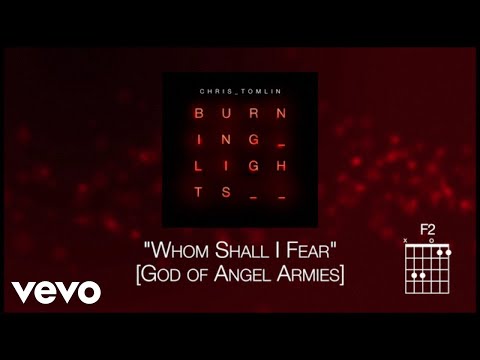 NOT A QUOTE
“Whom Shall I Fear (God of Angel Armies)”
Chris Tomlin
Sing it. Nothing here is presented as scripture. The question is Psalm 27's, the armies are the ones Elisha's servant saw with opened eyes, and the name that carries them comes from a paraphrase Bible's wording, not from this scene.
NOT A QUOTE
“Whom Shall I Fear (God of Angel Armies)”
Chris Tomlin
Sing it. Nothing here is presented as scripture. The question is Psalm 27's, the armies are the ones Elisha's servant saw with opened eyes, and the name that carries them comes from a paraphrase Bible's wording, not from this scene.✓ The scene behind the chorus is real and documented: the writers point to 2 Kings 6, and what the chorus says about presence, always at the singer's side, is verse 16's own point, those with us are more
⚠ No verse is cited and no translation is named, so the lyric gives a singer no road to Psalm 27, 2 Kings 6, or the title's own addresses. The links live in interviews and worship write-ups, not in the song
 ~ FAITHFUL
“Holy, Holy, Holy”
Audrey Assad
Sing it. The threefold cry is the verse, kept exactly. The Trinity line is the church's reading of that cry, stated openly. Knowing which layer is Isaiah and which is doctrine is the whole assignment here.
~ FAITHFUL
“Holy, Holy, Holy”
Audrey Assad
Sing it. The threefold cry is the verse, kept exactly. The Trinity line is the church's reading of that cry, stated openly. Knowing which layer is Isaiah and which is doctrine is the whole assignment here.✓ The seraphim's threefold cry is carried exactly, and every name the hymn gives God is one scripture gives Him
⚠ In the Hebrew, the threefold repetition is emphasis, the superlative at full strength. Naming the three persons in it is the church's later reading, not the verse's own statement